Author: Stein Tree

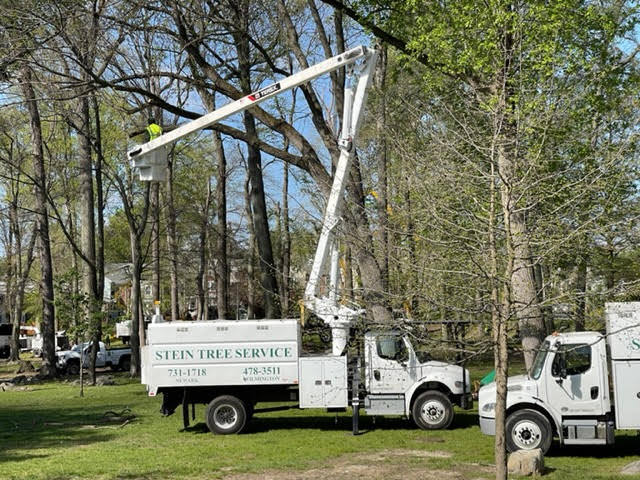
Tree care specialist using spider lift to trim large tree - Stein Tree Service

What Kind of Tree Care Can Be Done in the Winter?

With bare branches and frozen ground, winter can look like the off-season, but actually it’s a good time to reduce storm risk and catch tree problems early. Many winter tree care services are safer and more efficient during dormancy, and the results often show up as fewer broken limbs, fewer emergency calls, and healthier spring growth.

Below are some core winter tree care services Stein Tree Service performs each year, plus practical, homeowner-friendly steps you can take alongside professional work.

Checklist: “Is This a Winter Tree Care Moment?”

If you answer yes to any of these, it’s worth scheduling a winter inspection or estimate:

  • Dead or hanging branches over a roof, driveway, sidewalk, or power/service lines
  • A tree with visible decay, cavities, or mushrooms/fungal growth
  • Evergreens browning or thinning (possible winter drought/desiccation)
  • Bark cracking/splitting (possible frost damage or sun scald)
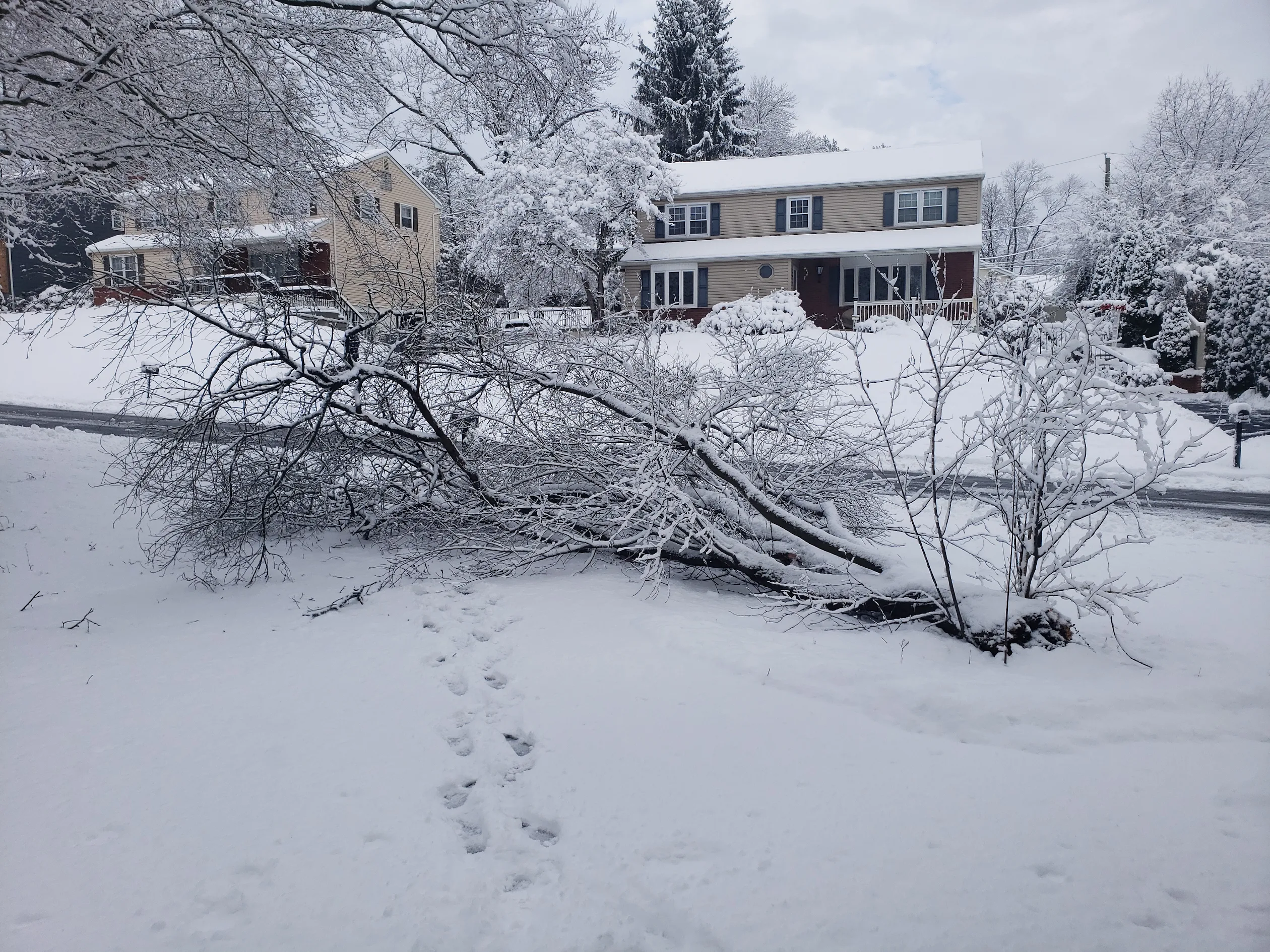
  • You’ve had repeat storm debris or blocked access/roadways

Winter Tree Care Services

Winter Tree Care Service Best For Helps Prevent
Tree inspection/risk assessment Any property with mature trees

Surprises in heavy snow/wind

Tree removal Dead/diseased/structurally unsound trees

Storm failures, property damage

Tree trimming & pruning Overfull canopies, dead/weak limbs

Limb breaks (Also provides safer clearances)

Right-of-way clearing Municipalities, HOAs, commercial sites

Blocked roads/access for repair crews

Winter desiccation treatment Evergreens, wind-exposed sites

Browning/needle loss

Frost protection tactics Young/newly planted trees

Bud/shoot damage, bark issues

Tree pest prevention Vulnerable species

Spring/summer pest infestations

Emergency storm clean up Storm-damaged trees/limbs

Secondary damage & hazards

Winter Tree Removal Services

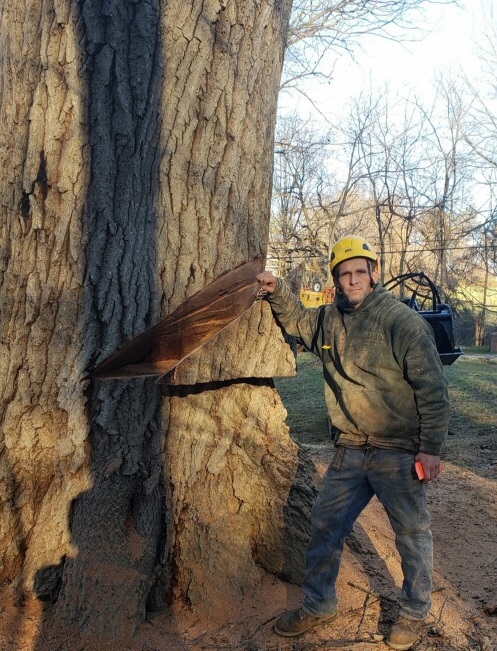
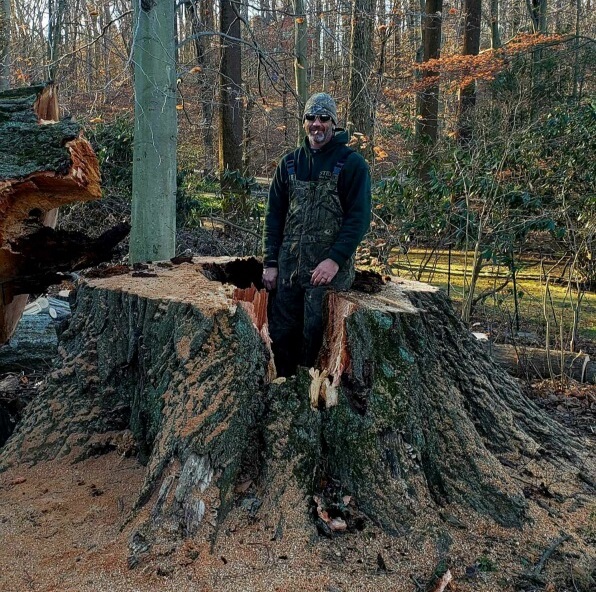
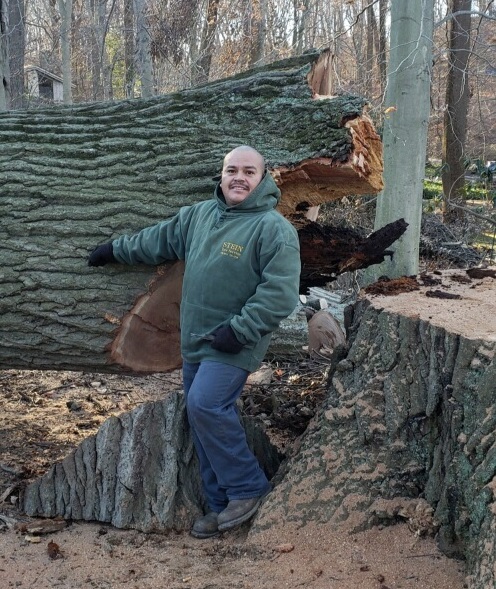
One example of winter work we’ve done was removing a large red oak with an enormous cavity. The trunk measured 27 feet in circumference and showed clear decline signs (including a large open wound and mushrooms). In winter, those structural issues can be easier to spot so homeowners can address a hazard before heavy snow or ice makes it fail.

Why is winter tree removal is often a smart call?

  • Dormancy = less stress on surrounding landscape.  Trees aren’t actively growing, and access is often simpler
  • Frozen ground can reduce turf impact when heavy equipment is needed (including cranes for larger trees).
  • Fewer “surprise failures.” Removing a high-risk tree now may reduce the chance you’re calling during a storm event.

  • Tree Removal Wilmington - Stein staff next to large oak tree with wedge cut

  • Winter tree removal of large oak with internal cavity – Stein Tree Service

  • large red oak tree removal tree downed beside tree stump - Stein Tree Service

Right of Way Clearing

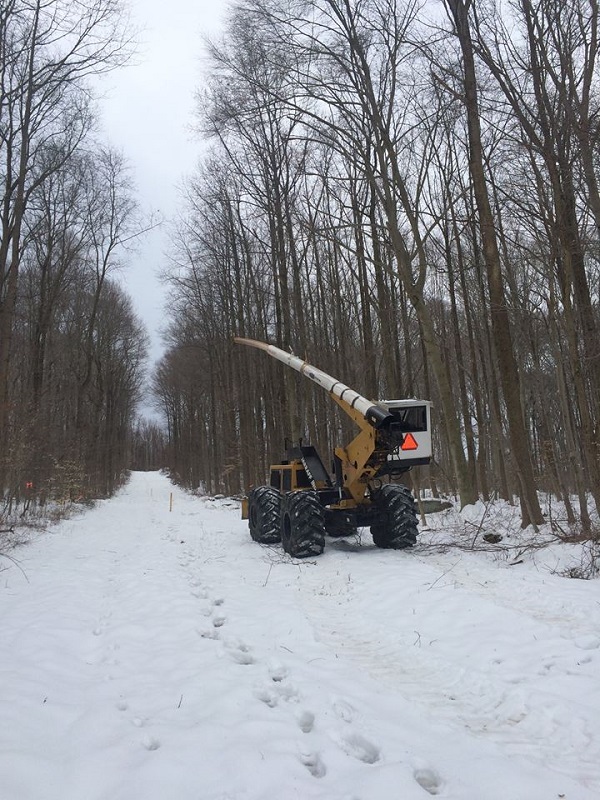
Right-of-way clearing is another winter tree care service we provide that is critical for access and safety. Roadways and access areas must be clear for traffic or repair crews, particularly if power is disrupted. We have the equipment needed and have performed right-of-way clearing and tree maintenance services for local municipalities, businesses, and even residents who have areas on their properties with trees that block access.

Winter Tree Trimming and Pruning Services

Winter is a good time for trimming and pruning because the trees are dormant and the bare canopy reveals dead, misshapen, or weak branches. Those branches are the ones most likely to crack under snow/ice weight

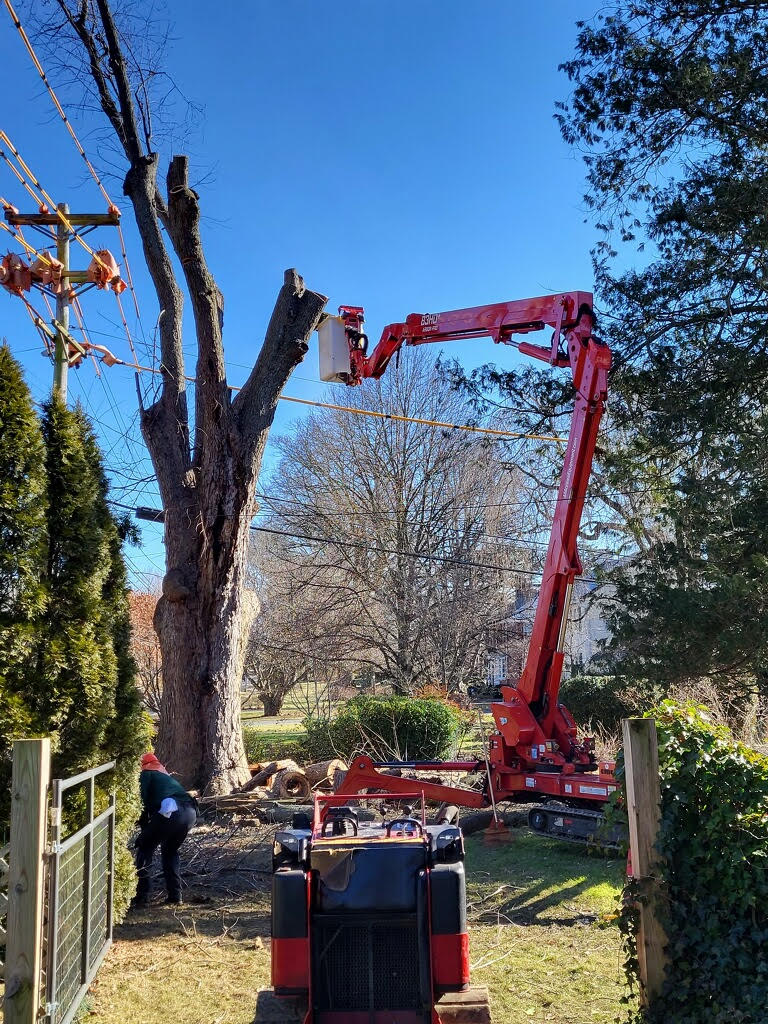
We also use specialized equipment, like our mini lift, affectionately nicknamed “the Spider,” (shown above) makes these services quicker, safer, and more efficient. View our video above to see how we can trim and remove trees from tight areas with homes nearby.

Practical winter tip: After a heavy snowfall, gently clear accumulated snow from reachable limbs to reduce limb break risk.

Pruning in winter is also a “tree health” move because dormant-season pruning typically means less stress on the tree and can reduce the likelihood that pruning wounds attract insects.

Winter Plant Health Care

Plant Health Care (PHC) matters in winter, too. One of the issues we get requests about in the winter is deer damage management. The deer cause damage in winter because when natural food sources drop, deer browsing can deform evergreens or strip buds. If you’re seeing chewed branch tips, missing buds, ragged foliage, or scraped trunks, this could be a sign of deer pressure on your property. Our deer repellent programs are aimed at controlling deer presence in your yard and protection of your valuable plant life.

Winter Desiccation Treatment

Winter desiccation is a type of injury that trees and shrubs can experience during winter. This injury occurs when a tree loses more water than the tree absorbs from the roots. As the ground freezes during winter, tree roots have a more challenging time absorbing water from the frozen ground while losing water due to transpiration.

Desiccation primarily affects evergreen trees, more so than deciduous trees, because evergreens transpire (give off water vapor) at a higher rate than deciduous trees.

The solution for this type of tree care is anti-desiccant sprays to help reduce moisture loss, which must be applied at specific times of the year and require careful application.

Emergency Storm Clean Up

When branches fail or trees come down in winter storms, response time matters. Stein Tree Service offers 24/7 emergency storm response. We will send our team of tree care professionals to evaluate the site as soon as it can safely be accomplished.

Why Homeowners, Property Managers, and Municipalities Schedule Winter Work

Winter is often the best time to:

  • Reduce storm risk before the next event hits (especially for trees overhanging structures/lines)
  • Get clearer visibility of structure/defects without leaves
  • Plan proactive pruning/removals with less disruption

Common Winter Tree Problems

These common winter tree problems affect trees all across our area. The harsh winter weather, including the sun and wind, can damage a tree’s roots, bark, and branches. Other issues involve pests and other harmful insects. Looking out for these issues will go a long way to ensuring your trees’ health and beauty.

  • Winter Drought

    Winter drought is a common issue mostly impacting northeastern evergreens. This type of drying out happens when trees lose more water than they can absorb. The ground freezes and the soil is either frozen or simply too cold for normal processes. Symptoms of winter drought include a browning of the tree’s leaves and twig and branch dieback.

    To avoid this problem, we advise regular fertilizing and watering before the dormant season to promote tree health. A thick layer of mulch may also help prevent soil moisture loss and reduce risks of freezing.

  • Sun Scalding

    Winter sun scalding is another common winter tree problem. Sun scalding is most common during clear, sunny winter days when the sun shines directly on a tree’s trunk and warms the tree up. This heat from the sun triggers a tree growth response. Once the sun sets and the temperature drops again, the new tissue growth is susceptible to damage (such as being frozen from snow and ice), and the tree is at risk of cracking and splitting.

    Sun scald can sometimes be prevented with reflective tree wraps. An ISA certified arborist can wrap the trunk, after the tree has gone dormant for the winter, to reflect the sun’s heat.To avoid this problem, we advise regular fertilizing and watering before the dormant season to promote tree health. A thick layer of mulch may also help prevent soil moisture loss and reduce risks of freezing.

  • Bagworms

    Bagworms do their damage during the summer when the larvae hatch and feed on your beautiful greenery. In the winter when the branches are bare, take time to inspect your trees to look for the tear-drop shaped bags where bagworm eggs reside. Removing them at this point is simple and will help prevent summer infestation.

Protecting Young Trees From Winter Damage

These are easy, high-impact actions that can improve your tree health along with professional winter tree care services:

  • Mulch correctly: a fresh organic layer under the drip line helps regulate soil temperatures and reduce moisture loss, but avoid piling mulch against the trunk (volcano mulching).
  • Protect young trunks: rodents may chew bark in winter, but you can use plastic guards or taller wire protection where deer pressure is high.
  • Water thoughtfully: fall watering helps trees enter winter better hydrated. Only water in winter when temps are above around 40°F and the area isn’t icy.

4 Methods of Protecting Trees From Frost

Frost damage can show as browning shoots/buds, bark cracking, and wilting young branches, especially on young or newly planted trees. Quick protection options include:

  1. Blankets. This is the simplest and fastest form of protection, especially when residents are caught unaware by a sudden freeze forecast. Just throw blankets or old clothes around the base of the tree for insulation.
  2. Hay. Instead of blankets, homeowners can also pile hay around the base of a tree to offer insulation and keep the surrounding ground warm.
  3. Hot water bucket with blankets or plastic sheeting. For this method of frost prevention, fill a 5-gallon bucket with hot water and place underneath a tree. Use a heavy blanket or plastic sheeting to cover the bucket and wrap around the tree. Over the course of a few hours, the hot water will evaporate but the heat will be trapped by the blanket and keep the tree warm.
  4. Drip lines. As with the previous methods, this method utilizes the principle that water that is warmer than air will protect trees from frost. For best effects, use blankets or plastic to help trap the energy expended during the evaporation process.

Why Choose Stein for Winter Tree Care Services

  • FREE
    Consultation

    We offer a free consultation with our experts to evaluate your landscape and its current or potential problems. We provide a solution based on YOUR landscape needs.

  • Expert Care by Certified Arborist

    Our arborist is ISA-certified and experienced in all types of plant and tree problems, including pests like emerald ash borer, plant and tree disease, and damaged trees.

  • Affordable
    Care

    Stein offers competitive rates for all of our services, including tree removal and emergency storm cleanup. We provide excellent value, balancing quality service with cost-effectiveness.

  • Licensed and Insured

    We are fully licensed and insured, so while our team consists of highly experienced professionals, our comprehensive insurance coverage means you’re protected against any unforeseen incidents. 

What Our Customers Say

See what a few of our customers say about our winter tree care.

What People Say

“Last night we had a heavy wet snow that brought down a tree right across the driveway. It’s a Sunday and they came out within a couple hours with bobcat type equipment and a wood chipper and finished and cleaned up in less than 30 minutes. And then they plowed the rest of the driveway I wasn’t able too earlier. Wow! Outstanding.”  – S.S.

“I’ve used Stein a number of times and it’s always a great experience. I have used them for tree pruning, tree removal and emergency tree removal for a tree that came down during a wind storm. Pricing is great and they took care of my emergency tree removal super quick.”  – N.N.

“The “spider” crew removed 3 dead trees in the yard to our new house. They were nice guys and incredibly fast getting the job done. I also really appreciated the front office’s quick response, flexibility, and professionalism when we were under contract and needed the tree work quoted.”
”  – M.D.

FAQs About Winter Tree Care

We get many questions from residents about tree care, our services, and our policies. Below are some of our frequently asked questions about tree removal and other services.

  • What winter tree care services can be done in winter?

    A lot, and winter is often a smart time to be proactive. Common winter tree care services include:

    • Tree inspections / risk assessments (easier to see structure with no leaves)
    • Trimming and pruning (dormant-season structural work, deadwood removal)
    • Tree removal
    • Storm damage clean up and emergency tree assistance
    • Right-of-way clearing, land clearing, and related site work
    • Stump grinding

    Best next step: If you’re not sure what’s urgent, start with a winter inspection.

  • Is winter a good time to prune or trim trees?

    Often, yes. Winter pruning can be ideal because:

    • You can spot dead/weak tree limbs more easily
    • Structural issues are clearer without foliage
    • Dormancy can make certain pruning work more efficient

    The “best time” can vary by species and condition. If you’re unsure, an on-site evaluation helps confirm the right approach for your trees.

  • Is winter tree removal possible?

    In many cases, yes. Winter removals are commonly scheduled. A quick site visit typically determines the safest removal plan and the best way to minimize disruption.

  • How do I know if a tree is hazardous in winter?

    Weaknesses can be more obvious in winter. Consider an inspection if you notice:

    • Dead or hanging limbs over a roof, driveway, sidewalk, or parking area
    • Cracks, splits, or a sudden lean
    • Cavities/decay or fungal growth at the base
    • Soil/root heaving after wind
    • A history of limb failures (repeat failures are a strong warning sign)
  • When should I schedule a winter tree inspection?

    Schedule sooner if:

    • You want to reduce storm risk before the next snow/ice event
    • You’re seeing any hazard signs above
    • You manage a commercial site, HOA, or municipal area where pedestrian/roadway safety matters
    • You’re planning site work and need a clear tree plan
  • Are you available for emergency services?

    Yes. We will send someone to assess the situation as soon as they can safely do so.

  • Are You licensed and insured?

    The crew at Stein Tree are tree care specialists with decades of collective experience and knowledge. In addition, our company carries more insurance than most other tree removal companies due to the nature of some industries where we provide services. They require us to have more insurance due to the danger involved. Therefore, we are more than covered for residential work. When asked, we can have our insurance agent provide you with a current certificate of insurance.

  • Are your team members properly trained?

    Our employees have gone through many hours of training to execute their jobs safely while on your property. We hold weekly safety meetings and constantly review safe working practices. All of our drivers are properly licensed to operate the size truck they are driving. We also require random drug testing.

  • What areas do you service?

    Stein Tree Service proudly provides expert tree care to residential, commercial, and municipal clients in Delaware, parts of southeastern Pennsylvania, and parts of Maryland. Our primary service areas include:

    Delaware: New Castle County, including Wilmington, Newark, and surrounding communities.

    Pennsylvania: Areas of southeastern PA such as Chadds Ford, West Chester, and Kennett Square.

    Maryland: We serve parts of northeastern Maryland, including Elkton, Chesapeake and Fair Hill.

    If you’re located near the Delaware border and are unsure whether your property is within our service range, feel free to contact us directly. We are happy to check and schedule a consultation.

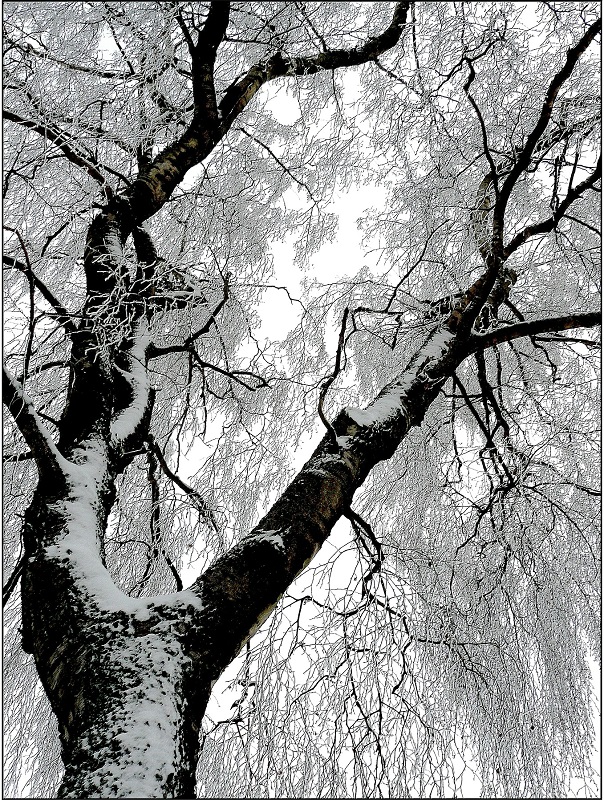
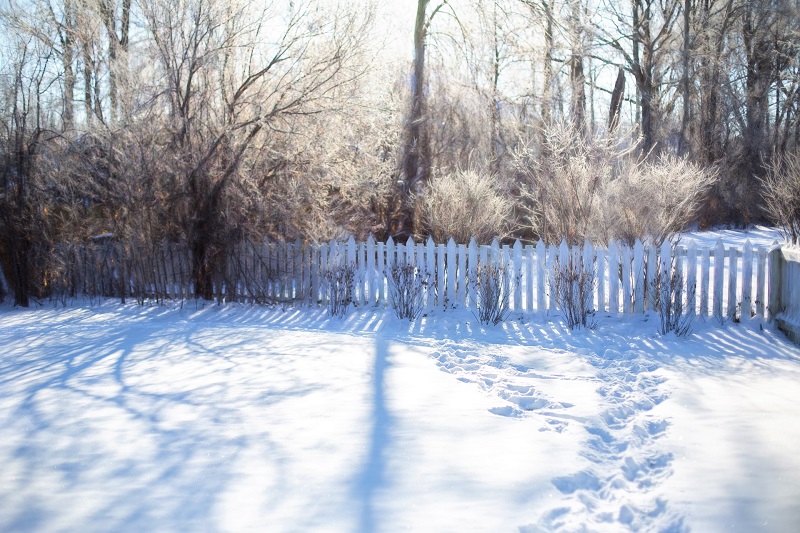
Ice covered tree in winter - Winter tree removal in Wilmington DE by Stein Tree Service

Call Stein Tree for Winter Tree Care Services

Winter can be hard on young and mature trees and it’s one of the best seasons to take proactive steps. Stein Tree Service provides winter tree care services including tree trimming and pruning, tree removal, right-of-way clearing, winter desiccation treatments, and emergency storm clean up.

If you’re unsure what your trees need, a winter inspection can help you prioritize:

  • Which limbs are true hazards
  • Whether a tree is a candidate for pruning vs. removal
  • Whether preventative treatments (wraps, anti-desiccants, cabling/bracing) make sense

Schedule a free winter consultation to get a clear, prioritized plan for your property’s safety and tree health before the next snow/ice event.

Get A Free Estimate

REQUEST A FREE, NO OBLIGATION CONSULTATION

Featured Programs

Inspect for Emerald Ash Borer infestation - Stein Tree Service - 1000

Spotted Lanternfly Quarantine Areas

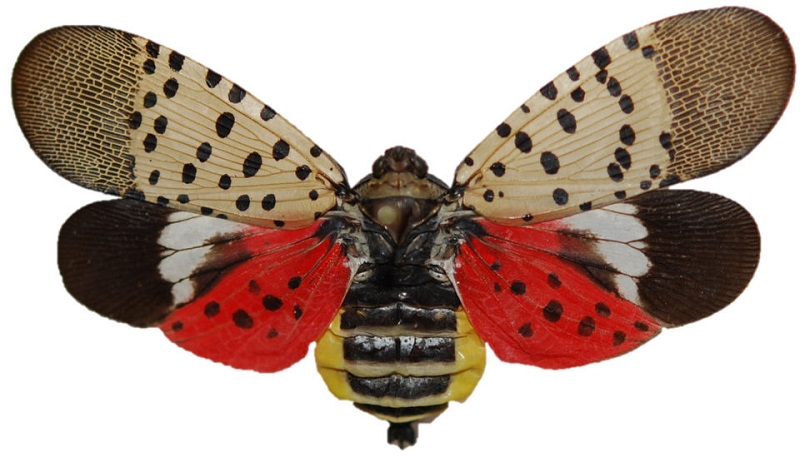
Stein has a permit to work in spotted lanternfly quarantine areas in Pennsylvania and Delaware. Tree Service Companies have to be trained in proper moving and disposal of materials to avoid spread of the spotted lanternfly and Stein has completed the training courses.
Read more

Inspect for Emerald Ash Borer infestation - Stein Tree Service - 1000

Emerald Ash Borer Inspection

In the spring, destructive ash borer (EAB) adult beetles begin to emerge.  These invasive pests can destroy your ash trees.  Our specialists are certified to treat for EAP in Pennsylvania and Delaware.  For A free consultation, contact us today.

Read more

Continue reading

Healthy Beech Leaves - What is Beech Leaf Disease BLD? - Stein Tree Service

What is Beech Leaf Disease (BLD)?

In North America, Beech Leaf Disease was first identified in 2012 in Lake County, Ohio, on native American beech (Fagus grandifolia). Since then, the disease has spread into the Mid-Atlantic region. Today, BLD is confirmed in all 67 Pennsylvania counties, multiple Maryland counties (including Anne Arundel, Howard, Baltimore, and Montgomery), and in parts of Delaware.

The disease is caused by a microscopic foliar nematode, Litylenchus crenatae mccannii, which overwinters in buds and damages developing leaves in spring. Spread of this nematode is believed to occur via rain, wind, animals, and human activity—making prevention a community-wide effort.

Signs and Symptoms of Beech Leaf Disease

Property owners in Delaware, Pennsylvania, and Maryland should watch for these telltale symptoms:

  • Dark banding, either dark green or yellow, between leaf veins, especially visible from below in backlighting (This leaf striping of symptomatic leaves is one of the most recognizable signs)
  • Leaf curling, puckering, thickening, or a leathery feel
  • Premature leaf drop, leading to thinning canopy coverage
  • Buds that fail to open in spring, leaving bare branches
  • Twig and branch dieback over time

Early detection is key to slowing the spread—especially in residential neighborhoods where beech trees may be close together.

Which Beech Trees Are Affected?

BLD impacts several beech species in our region:

  • American beech (Fagus grandifolia) — native to the Mid-Atlantic and common in forests
  • European beech (Fagus sylvatica) — a popular ornamental in landscapes
  • Oriental beech (Fagus orientalis) — less common but still susceptible

Both native and ornamental beeches in Delaware, Pennsylvania, and Maryland can develop BLD.

BLD Treatment and Management Options

While there is no permanent cure for Beech Leaf Disease, research by universities and forestry agencies has identified several treatments that may help slow progression and reduce symptoms in high-value trees. These methods are still considered part of an evolving management strategy and should be applied by trained professionals.

  • Trunk Injections with
    Arbotect 20-S (thiabendazole)

    Used under certain state allowances and experimental protocols, this fungicide has shown promise in reducing nematode populations and leaf symptoms, particularly on larger beech trees. Arbotect 20 S must be applied only by licensed applicators under SLN (Special Local Needs) labeling.

  • Fluopyram-Based Applications

    Fungicides/nematicides containing fluopyram have demonstrated early success in research trials, lowering nematode levels in affected leaves, especially in ornamental plantings.

  • Potassium Phosphite Bark Sprays

    Among the most studied approaches, twice-yearly phosphite bark sprays have been shown in trials to lessen leaf damage, defoliation, and twig dieback, with improvements becoming more apparent over multiple seasons. Although outcomes are promising—with potential benefits as early as one year—full benefits may take two to three years to be fully realized, according to research.

These treatments are most effective when combined with good Plant Health Care practices, such as proper watering, mulching, pruning, and nutrient management, to improve the tree’s overall vigor and resilience. Ongoing monitoring by a certified arborist is key to identifying changes in tree health and adjusting treatments accordingly.

The Risk for Delaware, Pennsylvania, and Maryland Landscapes

BLD can kill young trees within just a few years and cause long-term decline in mature specimens. For homeowners, municipalities, and property managers, losing beech trees not only affects aesthetics but also impacts shade, wildlife habitat, and property value.

Frequently Asked Questions About Beech Leaf Disease (BLD) and Tree Care

Below are answers from our arborist about common questions.

  • What is Beech Leaf Disease (BLD)?

    Beech Leaf Disease is caused by a microscopic nematode (Litylenchus crenatae mccannii) that damages buds and leaves, leading to dark leaf banding, canopy thinning, and eventual decline or death of beech trees.

  • In how many states has BLD been confirmed?

    Since its discovery in 2012 in Ohio, BLD has been detected in at least 15 U.S. states—including Delaware, Pennsylvania, and Maryland—as well as in Ontario, Canada.

  • What are the symptoms of BLD?

    Common signs include:

    • Dark green or yellowish bands between leaf veins
    • Curling, puckering, or leathery leaves
    • Premature leaf drop
    • Buds that fail to open in spring
    • Twig and branch dieback
  • Which beech trees are affected?

    BLD impacts native American beech (Fagus grandifolia), European beech (Fagus sylvatica), and Oriental beech (Fagus orientalis).

  • Is there a cure for BLD?

    No cure exists at this time. However, research-based treatments and good cultural care can help slow disease progression and improve tree resilience.

  • What does Penn State Extension recommend for managing BLD?

    Penn State Extension notes there is no permanent cure but reports that phosphite fertilizers may help improve a tree’s vitality and could suppress nematode activity. They also encourage regular monitoring and reporting of suspected cases.

  • What treatments are available for BLD?

    Research trials have shown that:

    • Arbotect 20-S (thiabendazole) trunk injections can reduce nematode levels in some cases.
    • Fluopyram-based applications have lowered nematode counts in ornamental settings.
    • Potassium phosphite bark sprays can reduce leaf symptoms, defoliation, and twig dieback.

    These should be combined with overall Plant Health Care practices for best results.

  • How quickly can BLD kill a tree?

    Young saplings may die within 2–5 years, while mature trees decline more slowly but are still at long-term risk.

  • Should I remove my beech tree if it has BLD?

    Not necessarily. Some trees may respond well to treatments, and others may show natural resistance. Consult a certified arborist before removing any tree.

  • Can BLD be prevented?

    Prevention is challenging due to the nematode’s ease of spread, but early detection and cultural management can help reduce impact.

  • What is Plant Health Care (PHC)?

    PHC is a proactive, holistic approach to maintaining tree and shrub health. It includes monitoring for pests and diseases, improving soil conditions, and applying targeted treatments when needed.

  • How often should I schedule a tree health evaluation?

    At least once a year is recommended, especially if you have mature trees or live in an area where pests or diseases like BLD are active.

  • What services does Stein Tree Service offer under PHC?

    Our PHC programs include disease and pest management, deep-root fertilization, structural pruning, tree risk assessments, soil care, and safe tree removal when necessary.

  • Why hire a certified arborist?

    Certified arborists have the training, experience, and credentials to accurately diagnose problems, recommend effective treatments, and ensure tree work is done safely and to industry standards.

Why Choose Stein Tree Service?

Stein Tree Service is the oldest independently owned tree service in Delaware. We have been providing exceptional tree care to homeowners and businesses for over 40 years, and our team is committed to helping your landscape’s trees and plants thrive.

Why Choose Stein Plant Health Care Services

  • FREE
    Consultation

    We offer a free consultation with our experts to evaluate your landscape and its current or potential problems. We provide a solution based on YOUR landscape needs.

  • Expert Care by Certified Arborist

    Our arborist is ISA-certified and experienced in all types of plant and tree problems, including pests like emerald ash borer, plant and tree disease issues, and damaged trees.

  • Affordable
    Care

    Stein offers competitive rates for plant health care and for all our services, including tree removal and emergency storm cleanup. We provide excellent value, balancing quality service with cost-effectiveness.

  • Licensed and Insured

    We are fully licensed and insured, protecting your interests as well as ours. While our team consists of highly experienced professionals, our comprehensive insurance coverage means you’re protected against any unforeseen incidents. 

What Our Clients Say About Us

Choosing a professional to care for your landscape’s plants and trees is a big decision, and great references can help make the choice easier. We get a lot of our business from word of mouth endorsements, because we are committed to treating your landscape like our own. See what a few of our clients have to say:

Complete Tree and Plant Health Care from Stein Tree Service

While Beech Leaf Disease is a growing concern, it’s just one of many threats facing trees in our region. At Stein Tree Service, our certified arborists are skilled in diagnosing and treating BLD through proven methods such as trunk injections, bark sprays, and customized care programs.

We also provide a full range of tree and plant health care services to protect and enhance your landscape, including:

  • Preventive health programs for a variety of tree species

  • Insect and disease management for pests such as borers, scale, and mites

  • Deep-root fertilization to improve soil health and nutrient uptake

  • Structural pruning to maintain tree safety and appearance

  • Deer Management to protect valuable trees and plants from damage

  • Tree removal when necessary for safety or landscape goals

Whether you need targeted BLD management or comprehensive landscape health services, our certified arborists are here to help your trees thrive.
If you suspect BLD or any other tree health issue—or want to proactively protect your landscape—contact Stein Tree Service today to schedule an evaluation with our certified arborist. We proudly serve communities across Delaware, Pennsylvania, and Maryland with professional, science-based tree care.

Schedule a Free Consultation

Stein' Tree Service new certified arborist, Daulton Weit

Meet our Certified Arborist

Daulton Weit is an ISA-certified arborist with 15 years of experience in the green industry. From the Wilmington area, he got his degree in horticulture from Williamson College of the Trades in Media, Pennsylvania. Weit also has a Delaware Pesticide Applicator Certification and the Penn State Tree Climbing School Certificate. His skills, knowledge and experience make him very well-qualified to diagnose and treat soil, plant, and tree issues in local landscapes

Our PHC Services for residences and commercial properties are available in Delaware,  Pennsylvania and Maryland. Some of our service areas are listed below.

Take the First Step Toward Healthier Trees – Schedule Your Free Consultation With our ISA Certified Arborist today!

Investing in our plant health services ensures that your trees and shrubs receive the expert attention they need to flourish, adding value and aesthetic appeal to your property. Contact us today to schedule a FREE consultation and take the first step toward a healthier, more vibrant landscape.

REQUEST A FREE, NO OBLIGATION CONSULTATION

Plant Health Care Locations Served


Pennsylvania

Continue reading

Stein Tree Service Achieves Maryland Licensed Tree Expert Status, Expands Services

Wilmington, DE – May 7, 2024 – Stein Tree Service, a leading provider of professional tree care in Delaware and Pennsylvania, is proud to announce that it has officially completed the Maryland Licensed Tree Expert (LTE) licensing process and is now authorized to provide comprehensive tree care services throughout the state of Maryland.

The Maryland LTE designation is awarded by the Maryland Department of Natural Resources and is required for any company or individual offering tree care services to the public in the state. To become certified, applicants must:

  • Demonstrate extensive experience in tree care practices
  • Pass a rigorous written and practical exam covering tree biology, diagnosis, safety, pruning, removals, and laws related to tree care
  • Hold or obtain appropriate liability and property damage insurance
  • Adhere to the Maryland Tree Expert Law and Code of Ethics for professional practice

Stein Tree Service van | Tree trimming in Claymont DE

“Our team is excited to bring our decades of experience and commitment to safety, environmental responsibility, and scientific tree care to communities in Maryland,” said Matt Grygiel, Owner of Stein Tree Service. “Earning the Certified Tree Expert status reflects our ongoing dedication to continuing education and quality service.”

As a now licensed and insured tree expert in Maryland, Stein Tree Service will provide a full array of services to residential, commercial, and municipal clients, including:

  • Tree trimming and pruning
  • Tree removal and stump grinding
  • Emergency storm response
  • Plant health care and pest management
  • Tree risk assessments by their ISA Certified Arborist & Certified Tree Risk Assessor
  • Tree preservation planning for construction sites and historic properties

With over 100 years of combined experience and over a 40 year history of serving the local community, Stein Tree Service has earned a reputation for reliable, knowledgeable, and responsive tree care. The company is known for its investment in state-of-the-art equipment, certified personnel, and a commitment to customer satisfaction.

The expansion into Maryland marks an important milestone in Stein Tree’s growth, allowing the company to support property owners in maintaining safe, beautiful, and sustainable landscapes in accordance with Maryland regulations and standards.

For more information about Stein Tree Service’s Maryland Licensed Tree Expert certified tree care in Maryland or to schedule a consultation, visit www.steintree.com or call (302) 478-3511.

About Stein Tree Service

Stein Tree Service has been a trusted provider of professional tree care in Delaware, Pennsylvania, and now Maryland since 1983. The company’s certified arborist and tree care professionals offer expert services tailored to the specific needs of each client, such as tree removal, tree trimming and shrub pruning, emergency tree services and storm clean up. with an emphasis on safety, tree health, and environmental stewardship. For more information or a free estimate, call 302-378-3511 or visit the company website at: www.SteinTree.com.

REQUEST A FREE, NO OBLIGATION CONSULTATION

Featured Programs

Inspect for Emerald Ash Borer infestation - Stein Tree Service - 1000

Spotted Lanternfly Quarantine Areas

Stein has a permit to work in spotted lanternfly quarantine areas in Pennsylvania and Delaware. Tree Service Companies have to be trained in proper moving and disposal of materials to avoid spread of the spotted lanternfly and Stein has completed the training courses.

Read more

Inspect for Emerald Ash Borer infestation - Stein Tree Service - 1000

Emerald Ash Borer Inspection

In the spring, destructive ash borer (EAB) adult beetles begin to emerge.  These invasive pests can destroy your ash trees.  Our specialists are certified to treat for EAP in Pennsylvania and Delaware.  For A free consultation, contact us today.
Read more

Continue reading

Young leaf, what is plant health care, Stein Tree Service

What is Plant Health Care (PHC) and Why Is PHC Important?

When an arborist is tasked with caring for a tree or shrub, their first step is to assess the plant’s health. We does this through a thorough assessment and creating personalized Plant Health Care (PHC) programs. What is plant health care? Plant health care is maintaining tree, shrub, bush, and general landscaping health proactively and holistically. Certified arborists and plant health care specialists focus on preventive care to increase the plant’s ability to thrive. Many factors contribute to caring for and maintaining plant health.

What Do Arborists & Plant Health Care Specialists Do?

The primary goal of plant health care is to provide the proper growing environment for various plants. An arborist needs to have an in-depth understanding of a tree so that he can accurately assess health issues and remedies. Knowledge of tree biology and how the tree interacts with environmental conditions is crucial to detecting any health problems. The arborist also needs good communication skills and must be able to work with the landscape proprietor.

What Does a Plant Health Care Program Include?

In terms of the physical work of plant health care, arborists may do any of the following based on their assessment of the landscape:

  • Targeted management of pests, insects, and diseases
  • Soil testing /pH testing
  • Fertilizing and mulching
  • Trimming and pruning

An important note is that plant health care is a continual process. Plants are living things, after all. So consistent monitoring, and especially early detection, are vital components of this process.

Some services we provide to care for a landscapes trees and plants are:

  • Seasonal fungicidal treatments
  • Systemic trunk applications
  • Horticultural oil applications
  • Deer Management
  • Tick Control

What Causes Plant Problems?

Now that we have the answer to our question, we must consider what causes plants to be unhealthy. While nature has plenty of self-regulating aspects to keep its elements healthy, trees and plants can still be harmed in many ways. The most obvious ways are insects, pests, and diseases, especially trees and shrub varieties that were introduced rather than native to the area. One of the major forces that affect plant health is people.

All of the traffic on your lawn, from both people and equipment and even the building of your house, compacts the soil, restricting root growth and nutrient absorption and resulting in stressed soil. Buildings, roads, and sidewalks are underground barriers to root growth. We want our trees and shrubs to thrive and be healthy, which means addressing these issues and finding solutions for our plants

The Vital Role of Soil Health in Tree and Plant Health Care (PHC)

When we think about tree and plant health care, one thing that is often overlooked is how vital soil health is to the trees and plant life. Trees need the proper amounts of various minerals for health and proper growth. They also need healthy soil with proper pH levels. Poor soil, or soil with inadequate or too high pH levels can result in poor tree health, evidenced by symptoms like unnatural leaf coloration.

According to the USDA, soil health means “the continued capacity of soil to function as a vital living ecosystem that sustains plants, animals, and humans.” To ensure that health, the proper elements must be available to nurture the good bacteria, the bugs, and other organisms that give the soil the ability to support and sustain our tree and plant health care.

What is the Role of Soil?

  • Controls water—Soil helps direct rain, snow, and irrigation water, collecting minerals as the water flows over.
  • Stores minerals and other nutrients—Minerals that plants need, like nitrogen and phosphorus, are stored in the soil.
  • Filters—Soil comes into contact with many materials, both organic and inorganic. The soil helps to filter out harmful elements.
  • Provides physical support—The soil holds the roots of trees and plants in place and gives them stability against wind and other forces of nature.

Benefits of Chemical-Free Soil Health

Maintaining healthy soil using no/minimal chemicals is optimal for plant and tree health care because this type of health is more sustainable and works with an area’s natural ecology. This ecology includes bugs and bacteria, things we typically try to avoid but that are important to the health of the soil.

Some types of bacteria are needed to help the soil and its plant life thrive. As we noted in a previous blog, planting native trees and shrubs is vital to keeping the local ecosystem intact. Helpful bacteria, the bugs that eat them, the birds that eat them, and so on are part of that cycle.

With chemicals, though they are sometimes necessary, those healthy bacteria are killed, plants become dependent, and they cannot produce nutrients independently. A certified arborist will assess your soil health and can advise you on the best tree and plant health care plan for your landscape.

Importance of Proper Soil Types

Soil type is important because some trees need more moisture and nutrients, and some types of soil can make getting the necessary elements difficult. The most common types are clay, sand, and silt.

  • Clay

    Clay is tightly packed and has little air space. This type of soil allows for little movement and makes absorbing water, air, and other nutrients into the soil difficult.

  • Sand

    Sandy soil is comprised of loose, large particles. Though more movement is allowed, this soil type has difficulty retaining moisture. 

  • Silt

    Silt has fine particles but is highly compacted. This compaction could work against trees or plants that need to spread out, but silt does retain water and other nutrients.

You may have more than one type of soil in your landscape, but either way, you can provide the proper soil environment if one does not already exist by mixing one or more types in the area around your trees and plants.

Why is Plant Health Care Important?

If you have wondered why plant health care is essential, you now know that the practice can help keep your landscape healthy and beautiful. Healthy trees and shrubs bring value to your property and your lives, and we want to help you retain your cherished trees.

Our comprehensive approach to plant health care allows us to detect issues early and resolve them through plans that provide long-term solutions to the many health risks our trees and landscape plants face.

How Do I Know If I Need Plant Health Care?

You need plant health care if you have plants and trees in your yard. Even if your trees look healthy, you should call an arborist to assess them and ensure your property is a healthy environment for trees to thrive. Additionally, if you have noticed that your tree foliage has changed color, has leaf spots, or other leaf damage, that may indicate that your plants are malnourished or infested.

Benefits of Choosing Stein for Plant Health Care Services

Why should you choose Stein for your plant health care needs? We are passionate about the health of your trees and landscape, and treat your landscape like our own. A few other reasons to choose Stein Tree Service are:

  • FREE
    Consultation

    We offer a free consultation with our experts to evaluate your landscape and its current or potential problems. We provide a solution based on YOUR landscape needs.

  • Expert Care by Certified Arborist

    Our arborist is ISA-certified and experienced in all types of plant and tree issues, including insect pests like emerald ash borer, plant and tree disease, and damaged trees.

  • Affordable
    Care

    Stein offers competitive rates for plant health care and for all our services, including tree removal and emergency storm cleanup. We provide excellent value, balancing quality service with cost-effectiveness.

  • Licensed and Insured

    We are fully licensed and insured, protecting your interests as well as ours. While our team consists of highly experienced professionals, our comprehensive insurance coverage means you’re protected against any unforeseen incidents. 

Call Stein Tree Service for Your Plant Health Care Services

Stein Tree Service hears questions like “What is plant health care?” and “How can I save my tree?” daily. The Stein Tree staff has over 40 years of knowledge and experience. Our long history of satisfied customers, from Wilmington to Philadelphia, represents our dedication to quality service. Contact us for a free plant health care consultation or more information on our successful plant health care programs.

home surrounded by green grass and trees - what is plant health care - Stein Tree Service

REQUEST A FREE, NO OBLIGATION CONSULTATION

Continue reading

Stein Tree Announces New Certified Arborist and PHC Services

Wilmington, DE – December 12, 2024 – Stein Tree Service is proud to announce the addition of a new certified arborist, Daulton Weit. This exciting development reflects the company’s commitment to providing top-notch tree care and expertise to the Wilmington community and beyond.

Weit is an ISA-certified arborist with 15 years of experience in the green industry. He is from the Wilmington area, graduated from Brandywine High School, and then continued his education, getting a degree in horticulture from Williamson College of the Trades in Media, Pennsylvania. Weit also has a Delaware Pesticide Applicator Certification and the Penn State Tree Climbing School Certificate.

“I am thrilled to join Stein Tree Service and contribute to the health and beauty of our community’s trees,” Weit said. “My passion for horticulture and commitment to environmental stewardship drives me to provide the best care possible.”

Plant Health Care Services

Some of the plant health care services offered by Stein Tree Service include:

  • Soil Evaluation
  • Fertilization
  • Root Care
  • Seasonal Fungicidal Treatments
  • Foliar Applications
  • Systemic Trunk Applications

Stein' Tree Service new certified arborist, Daulton Weit

About Stein Tree Service

Stein Tree Service is the oldest independently owned tree care service company in Delaware. The company performs tree care services such as tree removal, tree trimming and shrub pruning, emergency tree services and storm clean up. They are also licensed to perform inspections and treat for emerald ash borer in Delaware and Pennsylvania. The professional certified arborists and specialists are dedicated to exceptional tree care, and have been serving the needs of local communities for over 40 years. For more information or a free estimate, call 302-314-9938 or visit the company website at: www.SteinTree.com.

REQUEST A FREE, NO OBLIGATION CONSULTATION

Featured Programs

Inspect for Emerald Ash Borer infestation - Stein Tree Service - 1000

Spotted Lanternfly Quarantine Areas

Stein has a permit to work in spotted lanternfly quarantine areas in Pennsylvania and Delaware. Tree Service Companies have to be trained in proper moving and disposal of materials to avoid spread of the spotted lanternfly and Stein has completed the training courses.

Read more

Inspect for Emerald Ash Borer infestation - Stein Tree Service - 1000

Emerald Ash Borer Inspection

In the spring, destructive ash borer (EAB) adult beetles begin to emerge.  These invasive pests can destroy your ash trees.  Our specialists are certified to treat for EAP in Pennsylvania and Delaware.  For A free consultation, contact us today.
Read more

Continue reading

tree branch with yellow leaf, fall and winter are the best times for tree trimming, stein tree service

Fall and Winter are The Best Times For Tree Trimming

The warm, sunny days of spring and summer are behind us, and cooler days are here. Seeing the beautiful leaves from summer change color and fall off the trees is one great thing about fall, and those leaves falling is a good reminder that fall and winter are the best times for tree trimming and shrub pruning. You may have heard this before and wondered why, so today we discuss some of the reasons.

What Makes Fall and Winter the Best Times for Tree Trimming and Pruning

As everyone knows, deciduous trees lose their leaves in the winter, revealing all of the branches previously hidden under the foliage. Seeing the beautiful, colorful leaves fall off might make some people sad. However, bare tree branches do make the task of diagnosing issues and trimming trees much more manageable. In addition, the bare canopies of the trees make the tree structure much easier to see. As a result, arborists can more easily remove dead or vulnerable branches.

The frozen, snow-covered ground also helps arborists by allowing us to reach areas near the tree or shrubs that are usually inaccessible with our equipment. As much as we love leaves in the spring and early summer, having them out of the way makes our trimming and pruning easier. In addition, when the ground is frozen the equipment is less likely to compact the soil near the trees and shrubs.

Tree Trimming and Pruning Prepares Trees for Winter

Taking care of tree trimming in fall and early winter months is a proactive step. When winter snow and ice come, branches that are already vulnerable are more likely to fall. If they do, homeowners may risk harm to property or persons nearby. If trees receive regular maintenance like trimming and pruning, they are less likely to have branches that easily break.

Easier to Identify Issues

Deciduous trees lose their leaves in the winter, revealing all branches previously hidden under the foliage. Seeing the beautiful, colorful leaves fall off might make some people sad. However, bare tree branches do make the task of diagnosing issues simpler. In addition, the bare canopies of the trees make the tree structure much easier to see. As a result, arborists can more easily remove dead, vulnerable, or diseased branches. The frozen, snow-covered ground also helps arborists by allowing us to reach areas near deciduous trees without our equipment compacting the soil near the trees and shrubs.

Promoting Tree and Shrub Health

During spring and summer, trees and shrubs are growing. Dormancy allows wounds from winter pruning and trimming to heal more quickly since the tree is not expending energy on new growth.

Support Disease Management

Another reason that fall and winter are the ideal times for shrub and tree pruning is that disease and insect damage are less likely. Trimming and pruning during the late spring and summer can expose trees and shrubs to diseases. When decay occurs, the decay can attract insects to the tree and cause more damage.

Knowing your area’s trees, shrubs, insects, and diseases can be very helpful. A certified arborist or other tree specialist can advise you on the best practices for your space and your specific trees. Trimming and pruning in late winter, when insects are the least active, will help keep your trees and shrubs healthy.

Reduce Leaf Clean-up

If you hate raking your property every other week in the fall, now is a great time to call the professional arborists at Stein Tree Service. Our team will carefully and cleanly remove problem tree branches and thin trees to improve overall health, with the added benefit of reducing your late-fall leaf clean-up. Trimming before all the leaves fall can also help reduce gutter build-up where limbs overhang your Wilmington area home.

Special Tree Trimming and Pruning Concerns

Though late fall and winter through early spring are generally the best times for tree trimming, some exceptions apply.

Flowering Trees

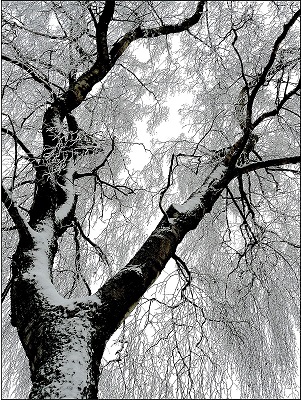
Icy Tree |Fall and winter are the best times for tree trimming and shrub pruning | Stein Tree
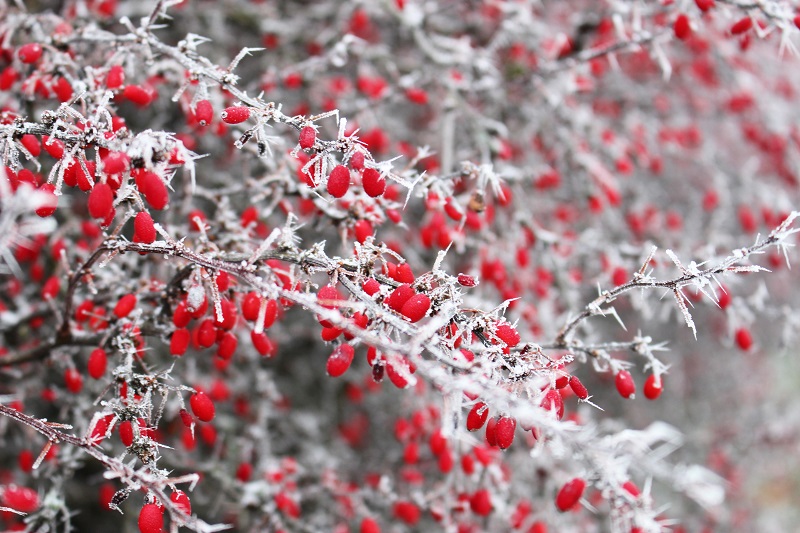
winter shrub with red berries | fall and winter are the best times for tree trimming and shrub pruning | Stein

As we have mentioned in a previous article, spring flowering trees should be pruned after they have flowered. This practice allows for the most blooms in the following year. More blooms lead to better aesthetic appeal and also aid in pollination.

Damaged Trees

If a tree is damaged and at risk of falling or losing branches, a delay in action may lead to injury or property damage. Knowing what to look for is essential. Here is a short list of issues to look out for that could cause mean “now is the best time to prune” ANY time of year.

  • Weak, damaged, broken, or diseased branches and shrubs
  • Branches and shrubs hanging over or making contact with power lines, roofs, sheds, or other structures
  • Trees that lean at dangerous angles

What Tree Issues Should Homeowners Look Out For?

Trees weakened due to disease, infestation, or something else are the most at risk for storm damage. Below are several signs that could indicate trouble for your trees.

Branches that hang over or make contact with power lines. If branches are already touching power lines, seek a professional tree care specialist to perform remedial tree trimming and pruning as soon as possible. If they are hanging over or leaning near power lines, they could cause problems in the next strong storm.

  • Branches that hang over roofs, sheds, or other structures. These tree branches could cause expensive property damage in a violent storm. If the trees overhang your neighbor’s yard, you could be liable for any damage to their property.
  • Trees that lean at dangerous angles. If a tree is leaning already, too much pressure could cause uprooting in wet and windy conditions. In such a situation, a professional can determine whether tree removal is necessary for safety.
  • Tree Decay. Mushrooms or other fungal presence on trees indicates a problem. Decay can cause tree weakness. Other signs of decay are unusual insect activity or hollow trunks.
  • Tree damage. Obvious damage to large limbs could weaken the entire tree, so it should be evaluated to determine the risk.

Contact Stein Tree for Quality Tree Trimming and Shrub Pruning Services

The fall and winter make for the best times for tree trimming and shrub pruning. However, whenever you need professional tree care, you can count on an experienced arborist from Stein Tree Service. Since 1983, Stein Tree Service has provided the residents of Delaware and Pennsylvania with tree services, including regular tree trimming, removal, and emergency services. For a free consultation, contact us today.

REQUEST A FREE, NO OBLIGATION CONSULTATION

Featured Programs

Inspect for Emerald Ash Borer infestation - Stein Tree Service - 1000

Spotted Lanternfly Quarantine Areas

Stein has a permit to work in spotted lanternfly quarantine areas in Pennsylvania and Delaware. Tree Service Companies have to be trained in proper moving and disposal of materials to avoid spread of the spotted lanternfly and Stein has completed the training courses.

Read more

Inspect for Emerald Ash Borer infestation - Stein Tree Service - 1000

Emerald Ash Borer Inspection

In the spring, destructive ash borer (EAB) adult beetles begin to emerge.  These invasive pests can destroy your ash trees.  Our specialists are certified to treat for EAP in Pennsylvania and Delaware.  For A free consultation, contact us today.
Read more

Continue reading

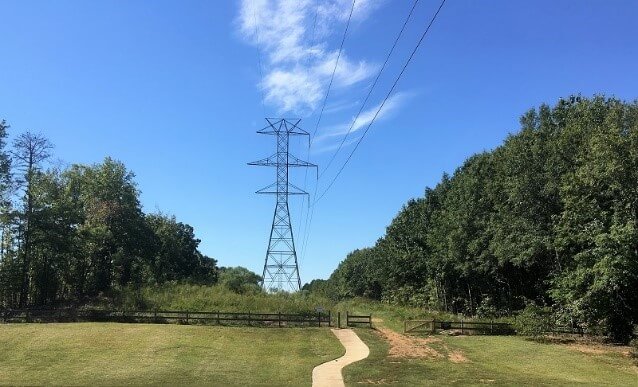
Professional Tree Service Company - right of way clearing for utility line

Why Is Right of Way Clearing Important?

As tree care professionals, one big aspect of our job is tree removal, and one of the tree removal services we provide frequently is municipal or commercial right of way clearing. Some might think that right of way clearing only refers to keeping roadway borders maintained, but many other types are actually more common.

What is Right of Way Clearing?

Right-of-way clearing involves removing unwanted trees and brush that overgrow their set boundaries. This boundary could be horizontal, including trimming and pruning overgrown trees to clear a walk, roadway, or access point. Or the boundary could be vertical, such as when trees grow up into power lines or structures.

What are the Different Types of Clearing?

Stein has provided right-of-way clearing for businesses, municipalities, school systems, and residents. Some common requests are:

Roadways

Both public and private roads necessitate a cleared space on either side for safety. A clear right of way encourages drivers to pull their cars entirely off the road when needed, creating a safer distance between them and passing vehicles. Moreover, a cleared area acts as a buffer in case of a falling tree, and a professional tree care company can identify potential hazards before they threaten passing cars and people.

Bike Paths and Walking Trails

Many cities and townships provide bike paths and walking trails for the benefit of their residents, and when they do, they have a responsibility to be sure that the areas are safe for passage. Clearing includes removing brush and keeping trees trimmed back from the path.

Pipelines and Utilities

Whether installing new pipelines and utility lines or maintaining them, the areas around these features must be clear to allow necessary access. When repairs are urgent, technicians have no time to waste waiting for someone to clear a path.

Cable & Fiber Optics

When businesses or municipalities need to lay and bury new cables, the surrounding areas must be clear of trees that could impede the path. If right-of-way clearing is neglected, tree roots can grow into the area and damage cables.

Railroads

Right of way clearing helps prevent delays or even accidents around railroad tracks and crossings. In addition to keeping brush away from the tracks, trees must be trimmed so that their branches are prevented from striking the cars passing by.

Fences

Fences in neighborhood common areas, along roadways, and around parks or residences benefit aesthetically from keeping the surrounding areas clear. In addition, keeping trees clear of the area helps prevent them from falling on or damaging the fences. This type of breach prevention is even more critical in rural areas, where animals might be penned.

Surveys or Construction

One of the most common needs for right-of-way clearing is when new construction is planned. Surveyors can more easily manage cleared land, and of course, before any building can begin, the area has to be cleared of brush and trees.

Why Is Right of Way Clearing Important?

Many businesses depend on nearby infrastructure, such as power lines or pipelines, to keep their company and staff productive. Maintaining the integrity of this infrastructure is crucial. Arborists provide right-of-way clearing maintenance to ensure the infrastructure businesses and residents rely on is accessible and safe from potential tree damage. Here are four reasons why right-of-way clearing is a vital service.

1. Prevent Infrastructure Damage & Maintain Safety

One of the most important reasons for right-of-way clearing is to keep the surrounding people and infrastructure safe. Some examples of scenarios where a tree is interfering with property and making the area unsafe include:

  • Branches that are too close to power lines
  • Weak trees near the sides of roads
  • Uncontrolled roots near an underground pipeline

In all these instances, a weakened tree can cause significant damage to people or property due to branches falling onto and cutting power lines or trees toppling over.

right of way clearing project - Stein Tree

Take a Look at Our Other Commercial Tree Services

Types of Damage Right of Way Clearing Prevents

Some of the types of damage that trees too close to power lines can cause include the following:

Power outages. When a tree branch hits a power line, a short circuit can result and lead to a power outage. This can be a significant inconvenience for businesses and residents. A blackout can also be dangerous if people rely on electricity for life-support equipment.

Fires. A fire can start if a tree branch touches a power line and arcs. This is a serious hazard, as power lines carry high-voltage electricity that can cause fires to spread quickly.

Electric shock. Trees growing near power lines pose an electrical hazard to anyone in contact with them at ground level. Given the right conditions, even if the trees and power lines are not touching, electricity can arc from the power line to nearby trees. This situation is hazardous and can be fatal to anyone near the tree, such as the workers responsible for maintaining the power lines.

Property damage. If a tree falls on a power line, the debris can cause costly damage to homes, businesses, and vehicles.

In addition to these direct hazards, trees that interfere with power lines can create indirect risks in an otherwise reliable power system. For example, if a power outage occurs due to a tree, traffic signals or streetlights may stop working, leading to traffic accidents.

Keeping Animals Away from Infrastructure

Another issue is that overgrown vegetation areas attract snakes, rodents, and larger animals like deer. Near a roadway, these animals can be hazards to drivers. For businesses that receive a lot of foot traffic, animals can carry unwanted diseases or insects that can put clients, family members, or pets at risk. Taking preventive measures by clearing these areas of unwanted or unsafe vegetation can significantly reduce the risk of injury or damage to people and property.

2. Improved Accessibility

Right-of-way clearing helps protect infrastructure from obstacles that may interfere with or obstruct travel. For example, hikers along a walking trail must carefully navigate an area where tree branches are low and close to eye level. Another example would be trees blocking work crews and vehicles from getting to their pipelines or utilities. By clearing these critical areas of overgrown trees and branches, people can easily, safely, and quickly move to their destination, which is especially vital in commercial or industrial areas.

3. Aesthetic Visibility

Land clearing improves a property’s aesthetics and visibility. Customers find properties with much vegetation appealing. Still, brush and trees that grow in the wrong areas or appear poorly maintained can detract from the impression. Selectively clearing out weeds, brush, and trees creates more usable space for workers, making the space more appealing and welcoming to potential customers.

4. Practical Visibility

Clearing out select plants and trees makes patrolling, inspecting, and monitoring those areas or infrastructure components easier. Think of how difficult it would be to inspect power lines with many branches and leaves obscuring them. Keeping these areas clear is necessary for workers to do their jobs properly, and by taking a proactive approach, you are keeping your business productive and reducing the likelihood of potential issues.

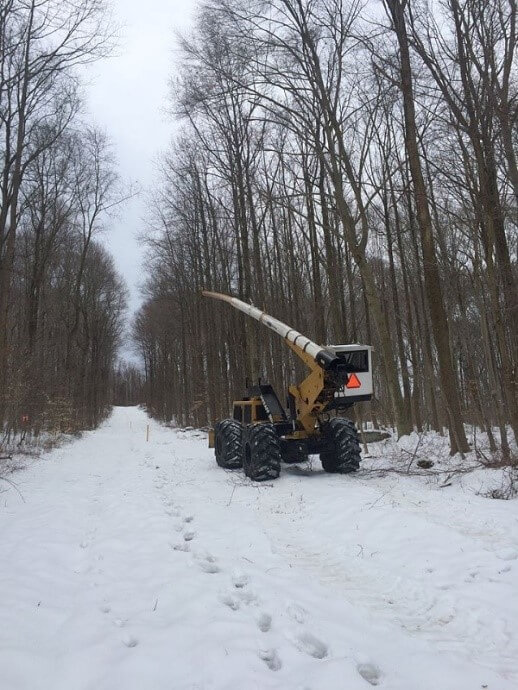
right of way clearing project in snow - Stein Tree

Contact Stein Tree for Right of Way Clearing

If you want to keep your commercial property healthy and safe for visitors and employees, contact Stein Tree Service. Our ISA-certified arborists have hundreds of years of combined experience and knowledge of up-to-date safety standards and regulations. Stein has provided businesses and municipalities with right of way and maintenance services in Pennsylvania, Delaware, and Maryland. We work to ensure your trees are healthy and beautiful and maintain your business’s safety. Contact us today for more information on right of way clearing or our other services.

REQUEST A FREE, NO OBLIGATION CONSULTATION

Featured Programs

Inspect for Emerald Ash Borer infestation - Stein Tree Service - 1000

Spotted Lanternfly Quarantine Areas

Stein has a permit to work in spotted lanternfly quarantine areas in Pennsylvania and Delaware. Tree Service Companies have to be trained in proper moving and disposal of materials to avoid spread of the spotted lanternfly and Stein has completed the training courses.

Read more

Inspect for Emerald Ash Borer infestation - Stein Tree Service - 1000

Emerald Ash Borer Inspection

In the spring, destructive ash borer (EAB) adult beetles begin to emerge.  These invasive pests can destroy your ash trees.  Our specialists are certified to treat for EAP in Pennsylvania and Delaware.  For A free consultation, contact us today.
Read more

Continue reading

Banner - Tree Worker in bucket lift - trimming trees in Newport DE | Stein Tree Service answers frequently asked questions about summer tree care

Frequently Asked Questions About Summer Tree Care

Summer is a crucial time for tree care, as the hot weather can pose various challenges for tree health. To ensure your trees thrive during the summer months, and all year, some elements of care are essential. As tree care professionals, we hear a lot of questions, and below are a few of the most common. Below, we answer some of the most frequently asked questions about summer tree care.

Continue reading

Emerald Ash Borer – Invasive Species Highly Destructive to Ash Trees

The emerald ash borer (EAB, or Agrilus planipennis) is a green beetle native to Asia and Eastern Russia. Outside its native region, the emerald ash borer is an invasive species, and emerald ash borer infestation is highly destructive to ash trees, having infested millions of ash trees in its introduced range. The Emerald Ash Borer was first discovered in the United States in Michigan in 2002. Experts believe the insect was brought to North America unintentionally in ash wood used to stabilize crates during shipping. Stein Tree Service offers helpful information about this invasive pest.

Life Cycle of the Emerald Ash Borer

A key part of emerald ash borer awareness is knowing the emerald ash borer life cycle. Understanding the life cycle will help you understand what to do when you see any activity on or around your property. Below are the different life cycle stages of this highly destructive invasive species.

View Our Tree Care Services

Adults

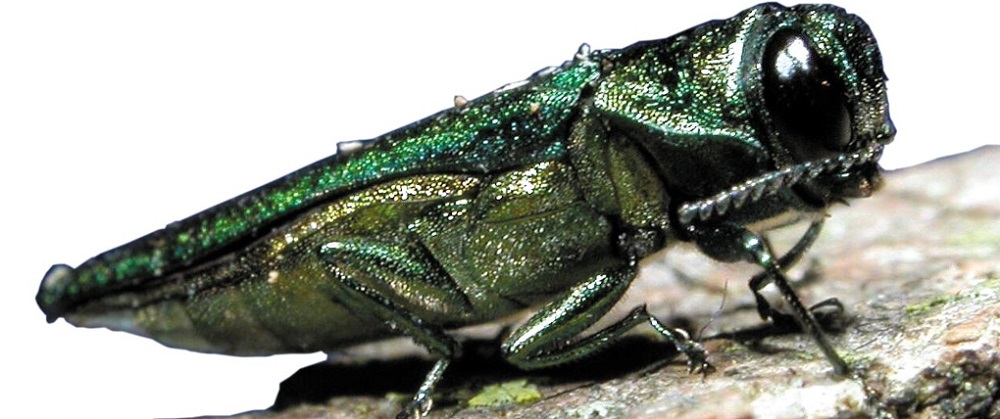
The adult emerald ash borer is a dark metallic green, bullet-shaped beetle, and about 1/3 inch long (8.5 millimeters), and 1/16 inch wide (1.6 mm). The body is narrow and elongated, and the head is flat with black eyes. After emergence, adults fly into the ash canopy, where they feed on leaves throughout their lives. EAB adults start mating one week after emergence, and females begin laying eggs 2–3 weeks later. A typical female will lay approximately 100 eggs during her 2-month life; 56% of these eggs, on average, will be female. EAB adults are readily observed mating and egg-laying on the trunks of ash trees on warm, sunny afternoons and evenings in the field. The adults of both sexes are strong fliers.

Eggs

A female EAB may lay more than 100 eggs in her lifetime, depositing them individually or in groups on the bark of ash trees along the trunk and portions of the major branches. Eggs are laid in areas where the bark is rough and between bark layers or in bark crevices. 

Eggs are approximately 1.0 mm long x 0.6 mm wide and creamy white when laid; fertile eggs gradually turn amber after a few days and hatch after about two weeks.

Larvae 

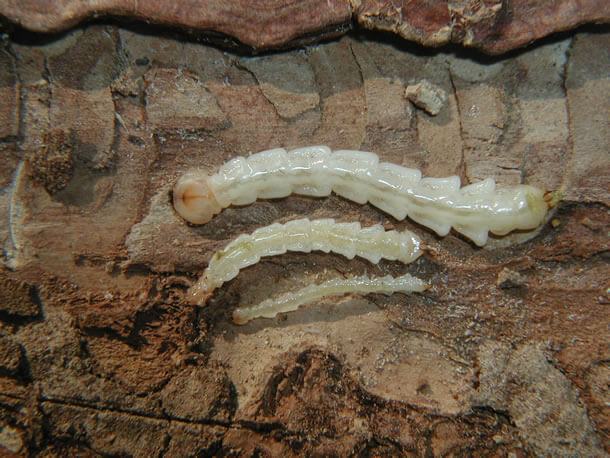
Newly hatched larvae bore through the bark to the phloem and outer layer of new sapwood, where they feed until the weather gets too cold in the fall. There are four stages of larval development (instars). As they feed, the larvae create long serpentine galleries filled with frass, which enlarge in width as they grow.

Larvae are creamy-white and dorso-ventrally flattened. When fully mature, fourth-instar larvae are 26 to 32 mm long. Their head is mainly retracted into the prothorax with only the dark brown mouth parts visible. The prothorax is enlarged, with the mesothorax and metathorax narrower. Larvae have 10 bell-shaped abdominal segments and a pair of small brown structures called urogomphi, which are characteristic of all larvae in the genus Agrilus.

Overwintering Larvae, Pre-pupae, Pupae, and Adults

In the fall, mature fourth-instar emerald ash borer larvae excavate pupal chambers in the sapwood or outer bark where they fold into overwintering “J-shaped larvae.” In the spring, the J-shaped larvae shorten into prepupae then shed their cuticle to become naked pupae. Pupae are initially creamy white, but the eyes turn red, and the bodies begin to darken as they develop.

Another critical aspect of emerald ash borer awareness is identifying signs of infestation. Adults chew D-shaped exit holes through the bark to emerge 

Emerald Ash Borer Larvae

from infested trees and can immediately fly upon emergence. EAB larvae that are immature as cold weather arrives in the fall will overwinter in their larval gallery. Larger larvae complete development the following spring, whereas smaller larvae may require another summer of feeding to complete development.

Symptoms of EAB Infestation

Look for these telltale signs that your ash tree suffers from EAB infestation. To properly identify the presence of this Asian native, look for a combination of two or more symptoms.

  • Crown Dieback – as a result of multiple years of EAB infestation, the larvae will disrupt the delivery of nutrients and water flow to the upper canopy, resulting in the dieback of the upper and outer crown.
  • Epicormic Sprouting – as a defense mechanism, your trees will try to ensure survival when sick or stressed. Signs of new growth at the tree’s base or on the trunk—often just below where larvae feed- indicate infestation.
  • Splitting Bark – feeding EAB larval galleries will develop surrounding callous tissue, causing vertical splits to the bark. One can see these larval galleries when the split bark is pulled away.
  • Woodpecker Feeding – woodpeckers love to feed on EAB larvae underneath the bark. With excessive feeding on large numbers of larvae, the damages will look like strips of the tree’s bark have been removed.
  • Distinctive D-shaped Exit Holes in Bark – emergence holes are made as the larvae mature into adult beetles and emerge from underneath the bark.

Effect on Trees

The most significant damage to a tree by EAB infestation occurs when the insect is in its larval stage. The larvae feed on the conductive tissue of the tree. This tissue transfers nutrients and water from the roots to the leaves, and when this transfer  is disrupted, the infested ash tree begins to die. At the onset of winter, the larvae relocate to the tree’s bark, effectively cutting off the tissue more. This ultimately results in the death of a tree. This can take place over several years, and the first noticeable sign is usually some die back in the crown of the tree. The tree will usually be dead by the following year or soon after. In areas where the insect is invasive and has no natural predators, the emerald ash borer can and usually does have a devastating effect on the local ash tree population.

Treatment

Prevention of the emerald ash borer infestation is possible by injecting a systemic insecticide into the base of the tree. This treatment can prevent damage to the tree for up to two years. Note that arborists must reapply application every two years.

Soil injections are another option for the prevention of EAB. These insecticides are injected directly into the soil surrounding the tree’s base and are then transported through the rest of the tree via the roots. For these treatments to have the greatest effect, the soil must be moist when applied. Waterlogged or dry soils will result in less insecticide being absorbed into the tree.

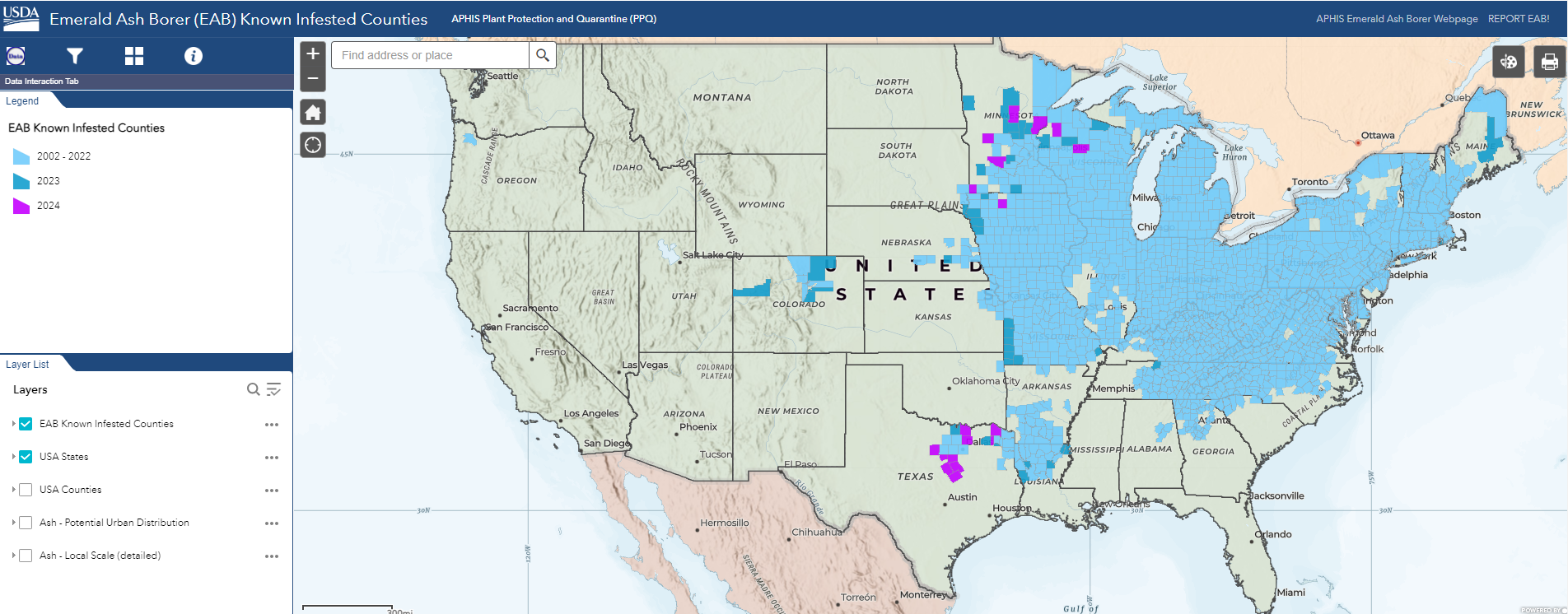
USDA Map of Emerald ash borer spread in US- emerald ash borer invasive species - Stein Tree Service

image courtesy of USDA

Arborists can use two insecticide spray treatments:

  1. The first is a spray applied to the trunk and absorbed through the bark. This treatment is less invasive to the trees and soil. However, absorption is slow and limited if the tree has thick bark.
  2. The second spray treatment is a protective cover spray applied to the branches and trunk of the tree. This treatment kills adult beetles and newly hatched larvae but will not kill eggs.

Emerald Ash Borer in Winter

While the wintertime cold temperatures kill off many insects and pests, emerald ash borer can survive the freezing winter temperatures. These pests spend the winter preparing to feed on nearby ash trees. EAB survive the winter due to them living within trees and a natural “supercooling” ability.

How does EAB Survive the Winter? Trees

When female emerald ash borer lay their eggs between June and August, the beetles lay eggs between layers of outer bark and cracks and crevices of the trunk and major branches. Once the eggs hatch, the larvae burrow deeper into the tree, feeding on the tree until becoming adults in early spring. The outer bark provides insulation to EAB from the cold weather, so the in-tree temperature is more relevant to EAB’s survival than the temperature outside the tree. Trees that receive much sunlight in the winter can also be warmer despite the cold weather. The other primary reason these beetles can survive cold weather is supercooling.

Supercooling

Supercooling lowers the temperature of gases or liquids below the freezing points without becoming solids. Many animals use supercooling by producing antifreeze proteins that bind to ice crystals, preventing water molecules from binding to the ice crystals and the ice from spreading. Insects can also create these proteins and other sugars or alcohols to prevent themselves from freezing and improve their cold tolerance. Supercooling is common among insects, and that process is the other primary reason why EAB survives the winter.

Emerald ash borer’s supercooling has a limit on how low the temperature can get to be helpful. Most research has shown that a significant portion of larvae begins to die at around -10°F and the number increases with the lower temperature. The icy weather conditions needed to do so are much more common in northern, colder regions such as the Midwest or Canada. Pennsylvania, Delaware, and Maryland winters are unlikely cold enough or may only have short, extreme cold snaps instead.

What You Can Do During Winter

If you want to keep your trees safe from the effects of EAB, here are a few things you can do during the winter while EAB larvae are dormant and have yet to spread to other trees.

  • Look for signs of emerald ash borer on your property and among your trees.
  • Get your trees inspected by a professional, certified arborist.
  • Remove EAB-infested trees and care for surrounding trees to reduce the risk of future infestation.

Removing trees infested with EAB can be done carefully at any time, but the ideal times to remove trees are during the fall and winter. From October to May, EAB is mostly inactive, with the larvae burrowing under the bark of a tree. The dormancy results from the beetles protecting themselves from the cold weather. Because the pest is primarily dormant during the winter, the chances of the pest spreading are reduced. Therefore, the ideal time to remove infested trees is between October and May, with the lowest risk of other ash trees becoming infested.

Emerald ash borer’s supercooling has a limit on how low the temperature can get to be helpful. Most research has shown that a significant portion of larvae begins to die at around -10°F and the number increases with the lower temperature. The icy weather conditions needed to do so are much more common in northern, colder regions such as the Midwest or Canada. Pennsylvania, Delaware, and Maryland winters are unlikely cold enough or may only have short, extreme cold snaps instead.

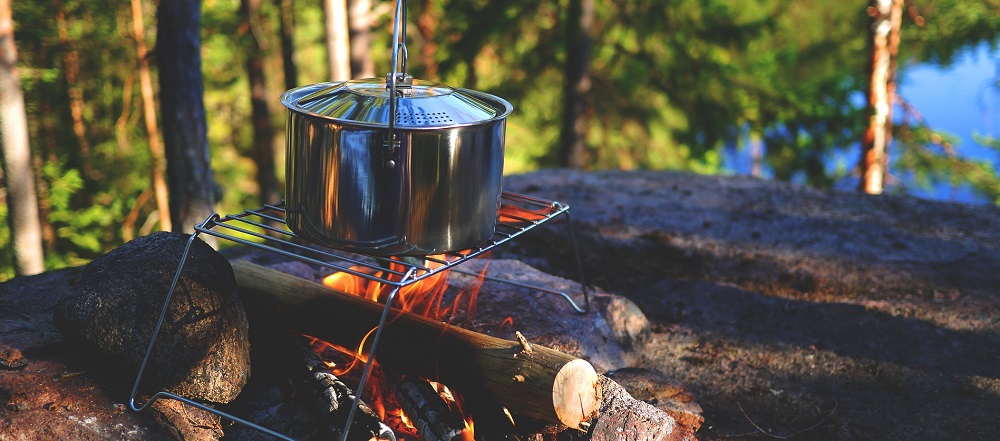
Camping & Preventing Emerald Ash Borer Spread

If you love camping, be careful about transporting firewood, as that is one of the ways Emerald Ash Borer has spread throughout the United States. First, be aware that improper handling and movement of firewood could cause the spread of invasive pests, such as the emerald ash borer  Stein Tree Service warns that the emerald ash borer is dangerous to various ash and olive tree species, and failure to follow handling guidelines could spread the insect to the camping area you visit or to your home trees if you transport wood from the site.

If you plan to have a campfire, and campfires are allowed at your site, purchase wood at the campground. This practice is generally recommended to avoid introducing non-native insects to a site. However, the emerald ash borer is particularly harmful and destructive.

campfire - be aware of threats such as emerald ash borer and the lone star tick when camping - Stein Tree Service

Contact Stein Tree Service for A FREE, No-Obligation Consultation

ITo ensure your property has healthy ash trees from emerald ash borer invasive species,  contact Stein Tree Service at (302) 478-3511 to request your free, no-obligation consultation with one of our tree specialists.

REQUEST A FREE, NO OBLIGATION CONSULTATION

Featured Programs

Inspect for Emerald Ash Borer infestation - Stein Tree Service - 1000

Spotted Lanternfly Quarantine Areas

Stein has a permit to work in spotted lanternfly quarantine areas in Pennsylvania and Delaware. Tree Service Companies have to be trained in proper moving and disposal of materials to avoid spread of the spotted lanternfly and Stein has completed the training courses.

Read more

Inspect for Emerald Ash Borer infestation - Stein Tree Service - 1000

Emerald Ash Borer Inspection

In the spring, destructive ash borer (EAB) adult beetles begin to emerge.  These invasive pests can destroy your ash trees.  Our specialists are certified to treat for EAB in Pennsylvania and Delaware.  For A free consultation, contact us today.

Read more

Continue reading

Tree Trimming and Pruning in Wilmington, DE

Prepare Trees for Summer Thunderstorms and Adverse Weather

May brings plenty of summer thunderstorms and adverse weather to Delaware and Pennsylvania. Those thunderstorms, in turn, bring plenty of risks to properties that have trees, especially fully-grown ones. If these trees are not properly prepared for powerful storms, they can significantly threaten your property and safety. As a result, homeowners need to practice proper tree trimming and pruning in their landscapes to reduce the risks of damage to their homes, nearby structures or vehicles. Below are tips on how to prepare trees for summer thunderstorms.

1. Consider Tree Risks & Get Your Trees Inspected

You should first evaluate potential risks to prepare your trees for summer thunderstorms. Your trees provide many benefits but can also become a liability if they receive inadequate care and maintenance. Some of these risks may be difficult for the average homeowner to spot and may require a trained professional to recognize.

As you prepare trees for summer thunderstorms, work with an arborist to help identify potential risks during heavy winds and storms. To ensure you enjoy a safe environment on your property, your arborist may recommend various treatments after completing a tree risk assessment. These may include:

    •  Tree trimming and pruning
    • Cabling and bracing
    • Tree removal

    Regular tree inspections are crucial for maintaining safe and healthy trees. You can identify potential risks early and take appropriate action by inspecting them for signs of decay, pest infestations, and other problematic issues. For instance, if your trees are near a structure like your home or garage, you can remove any overhanging limbs that may cause damage during a summer thunderstorm or adverse weather. A professional tree care service company, like Stein Tree Service, can help you evaluate the health of your trees and resolve issues such as overhanging branches, especially if those hazardous branches are in particularly difficult areas, like near power lines.

    2. Get Your Trees Pruned or Trimmed

    Pruning trees to remove dead or weak branches is especially important for two reasons.

    1. Regular pruning helps significantly reduce wind resistance or drag on trees and prevent damage in intense storms. However, over-thinning is a risk, so work with a tree specialist to ensure proper results from tree trimming and pruning of landscapes.
    2. The strong winds during a thunderstorm can cause weak or dead branches to break and fall, damaging nearby property or injuring people. So, pruning and trimming can be an effective aid to prepare trees for summer thunderstorms.

    Pruning and trimming is also good preventive maintenance for other issues that affect trees, like pests and diseases.

    3. Get Preventive Tree Care

    Summer storms and adverse weather can bring lightning, strong winds, and heavy rain. Lightning, in particular, poses significant risks to trees. However, with the right preventive measures, you can minimize the risk of lightning strikes and preserve your tree’s health. Tree lightning protection strategies, for instance, can help keep your trees safe, healthy, and protected. By investing in such preventive care, you’re ensuring the long-term safety and health of your trees.

    If a tree is located less than 10 feet from a structure and is struck by lightning, the strike can jump, or side-flash, to conductive materials on your house, like downspouts and gutter systems. So, by taking preventive measures to protect your tree from lightning, you can reduce the risk of damaging your home at the same time.

    What to Do After a Summer Storm

    Like preparing trees for summer storms, post-storm care is essential to prompt and proper tree care in Wilmington, DE. While the Southeast’s hurricanes and tropical storms dominate the national news waves, in the north, we have our notorious nor’easters and other strong thunderstorms to worry about from September to April. The following is a quick look at what professional arborists inspect and recommend following a large storm:

    Begin With a Visual Inspection

    Following a storm, the first thing to do is to complete a visual inspection, first at a distance, and if no large dangers are seen, do a walkthrough of your yard. Call tree care professionals such as Stein Tree Service immediately for big jobs or dangerous situations. Danger signs include:

    • Hanging or otherwise broken tree branches overhead
    • Splits in tree trunks or branches
    • Tree leaning
    • Signs of upheaval in soil at a tree’s base
    • Limbs falling over utility lines
    • Newly visible root systems
    • Fully uprooted or toppled tree

    Start Small and Go Bigger

    In areas without the above issues, a sound system for clean-up is to start small and work up

    Lightning Strike Tree | prepare trees for summer thunderstorms | Stein Tree Service

    to bigger items. Small twigs, leaves, and debris can easily be picked up and put in the appropriate trash bins. Smaller and mid-sized branches may be dried out for later use during the fall as fire kindling.

    Saving a Split Tree

    Even if your favorite tree was split during a strong storm, the tree may be salvageable. Consult with an arborist as soon as possible following the damage.

    Replacing a Leader

    If a tree’s leader has been completely lost to storm damage (or disease), with good tree care in Wilmington, DE, you might be able to have training for a replacement leader. Training a replacement leader — in other words, replacing the main trunk of a tree due to situations like canopy loss or complete splitting — is a form of storm damage arborists treat. This process typically involves selecting a new branch as the main trunk and guiding its growth to ensure it develops into a strong, central leader. Encouraging a replacement requires continual monitoring, with pruning done on at least a quarterly basis. Your beloved tree may thrive once again if proper tree care is practiced.

    Call Stein Tree Service for Skilled Tree Trimming and Pruning in Wilmington, DE, and Nearby Areas

    Stein Tree Service can help with all tree trimming and pruning on your Wilmington, DE property. Prepare trees for summer thunderstorms and adverse weather with professional trimming and pruning. Contact us today for a free consultation.

    REQUEST A FREE, NO OBLIGATION CONSULTATION

    Featured Programs

    Inspect for Emerald Ash Borer infestation - Stein Tree Service - 1000

    Spotted Lanternfly Quarantine Areas

    Stein has a permit to work in spotted lanternfly quarantine areas in Pennsylvania and Delaware. Tree Service Companies have to be trained in proper moving and disposal of materials to avoid spread of the spotted lanternfly and Stein has completed the training courses.

    Read more

    Inspect for Emerald Ash Borer infestation - Stein Tree Service - 1000

    Emerald Ash Borer Inspection

    In the spring, destructive ash borer (EAB) adult beetles begin to emerge.  These invasive pests can destroy your ash trees.  Our specialists are certified to treat for EAP in Pennsylvania and Delaware.  For A free consultation, contact us today.
    Read more

    Continue reading