Author: Stein Tree

Top 10 Things to do This Spring for your Trees, Shrubs & Plants

Spring is here, and while many people focus on spring cleaning their homes, the trees, shrubs, and other plants that make up your landscape also need some TLC. The end of winter is the best time of the year to think about how you want your yard to look in the coming spring and summer. With that thought in mind, Stein recommends some winter cleanup activities and spring preparation to aid the landscape’s overall tree and plant health care. We have compiled a list of the top 10 things you must do this spring to keep your landscape beautiful and valuable.

1. Trimming and Pruning Trees and Shrubs

Dead or broken branches on your trees and shrubs are future breeding grounds for disease and pests, and one way to prevent this problem is pruning and trimming. Pruning and trimming involve selective, precise cuts on certain branches that enhance plants’ health while maintaining their appearance.

Dead, broken, or weak branches pose safety hazards for people and any surrounding property. For example, we have worked with some local customers who saw that strong winds have caused trees to fall in their yards or into their neighbors’ yards. To mitigate these risks, trimming dead branches or thinning them when necessary can help reduce friction when wind storms occur and also allow better airflow.

Pruning can create beautiful visuals, stimulating lush foliage and plentiful blooms. However, when done incorrectly, pruning can severely damage the tree, reducing its ability to acquire proper nutrients. Professionals will be able to evaluate each tree and provide experienced pruning to improve tree health and safety.

2. Monitor for Pests

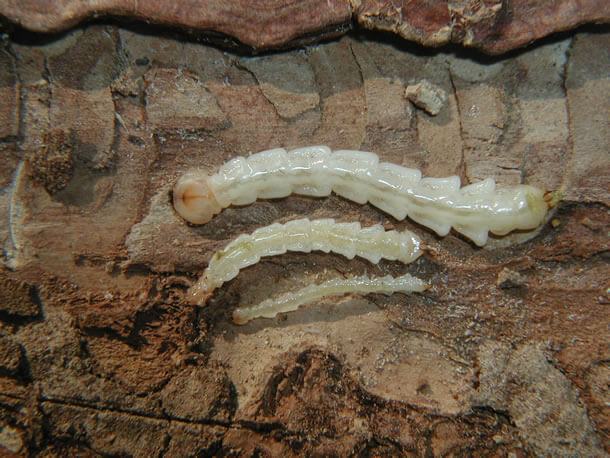
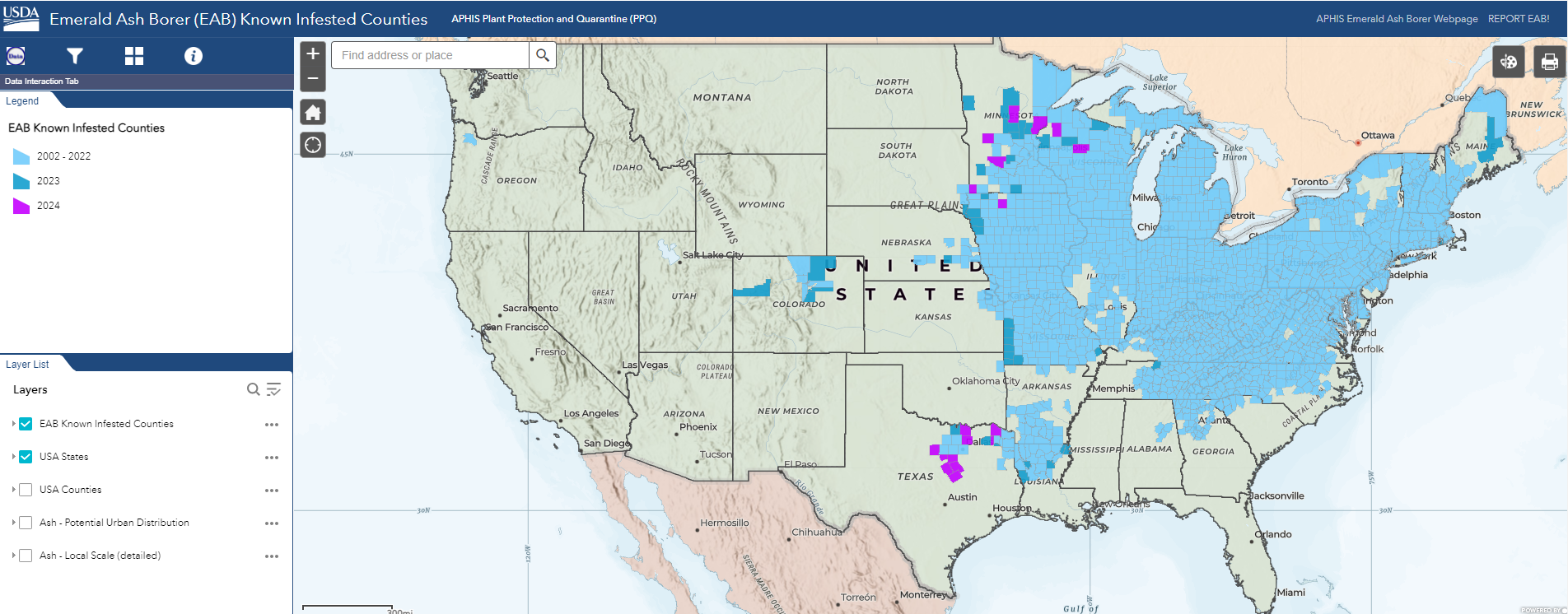
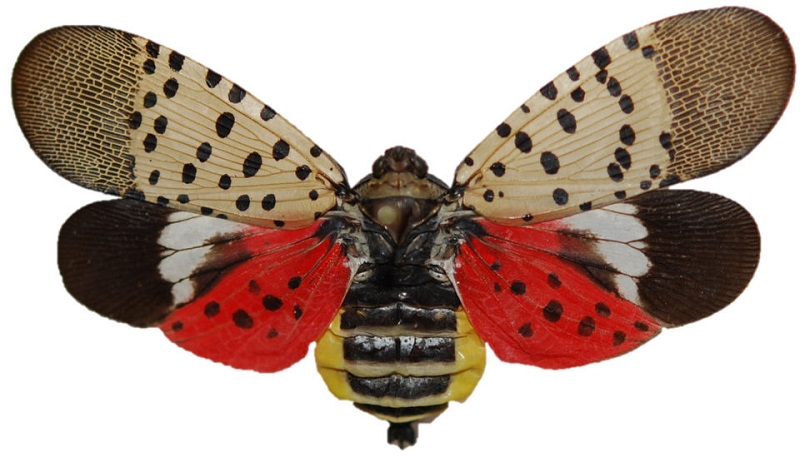
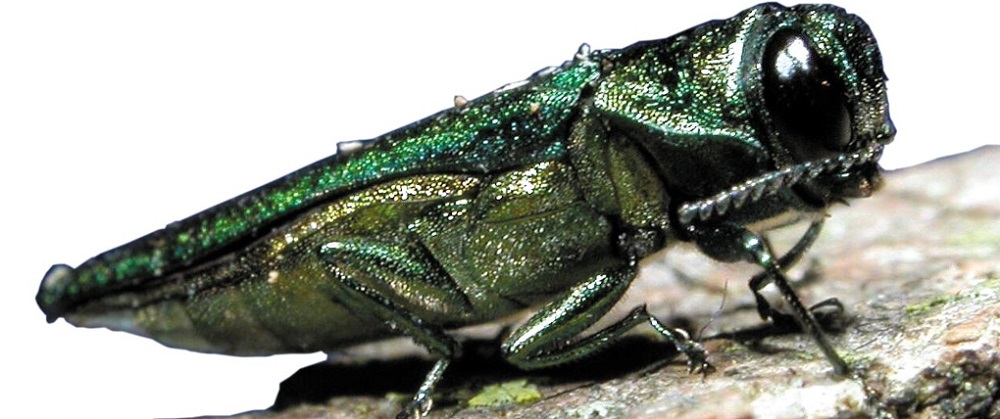
In spring, a variety of pests come into action and pose a threat to your landscape. One such common pest is the emerald ash borer, which causes significant damage to ash trees. These pests feed on a tree’s bark, disrupting the tree’s ability to transport vital nutrients and water, eventually leading to death. Other common pests in Pennsylvania and Delaware include spotted lanternfly, which leaves oozing, weeping wounds in the trees as the eggs are laid and hatched within the trunk.

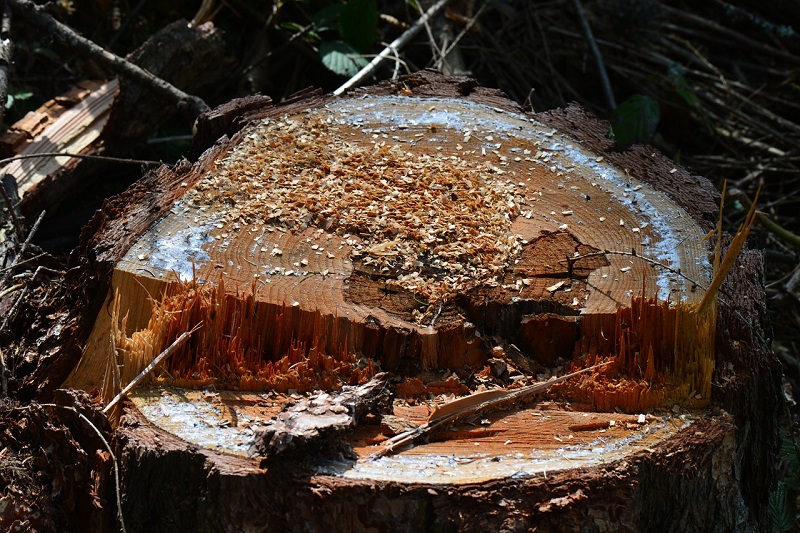
To help prevent any damage from these pests, keep a close eye on your landscape for early signs of pest infestation. These pests leave signs on trees or shrubs, such as tiny holes in the bark, sawdust at the base of the tree, dead branches, and thinning canopy that can alert you to their presence. If you notice any of these signs, contact an arborist who can inspect your trees and diagnose any issues. The arborist can suggest various treatment options, including insecticides or pruning of the affected branches, depending on the severity of the infestation.

3. Beware of Brown Leaves

Spring is the season of growth and renewal. For trees, this means the emergence of fresh green leaves. If you have trees on your property, keep an eye on the color of their leaves during this time. If you observe any brown or curled leaves, they may indicate a problem with the tree’s health. An arborist can inspect your tree, identify the underlying issue, and determine the best action to remedy the situation.

4. Fix Winter Damage

After the winter season, inspecting your trees for any damage caused by winter storms, ice, and cold temperatures is essential. Look for signs of damage, such as broken branches, bark splitting, and sun scald.

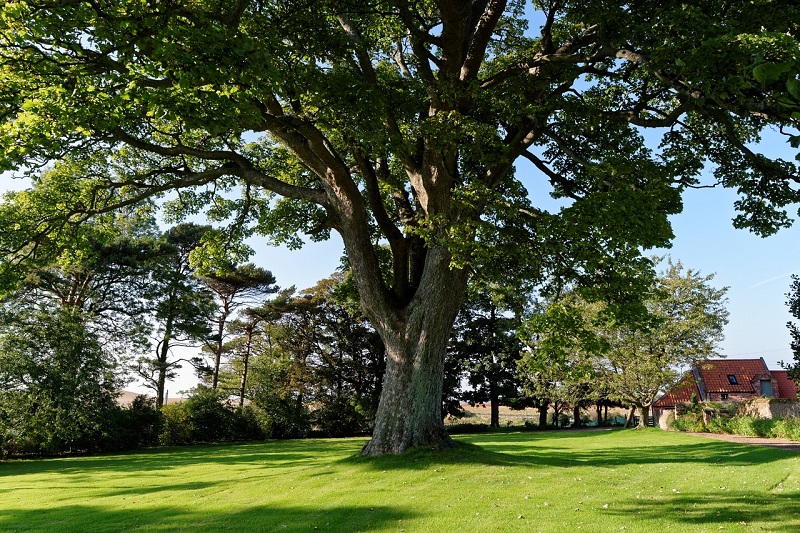
    Large tree in a big yard - Stein discusses Things to do This Spring for your Trees
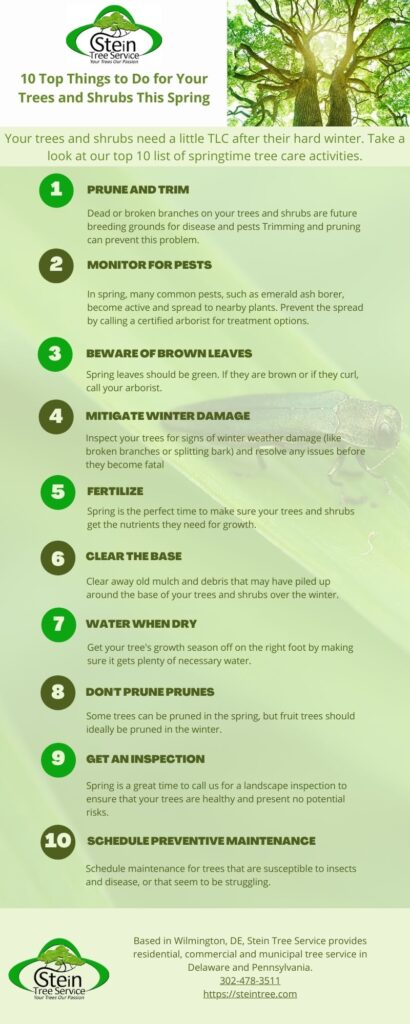
    Infographic of Top 10 Things You Need to Do This Spring for Your Trees and Shrubs

    • Broken branches can be pruned to prevent further damage.
    • Bark splitting can be repaired with a tree wrap.
    • Sun scalds, caused by the sun warming up the bark during the day and then cooling down at night, can be prevented by wrapping the trunk with light-colored tree wrap.

    By taking these steps, you can help ensure the health and longevity of your trees.

    5. Ensure Proper Soil Composition

    As with most vegetation types, trees require a special blend of soil nutrients, PH levels, and moisture retention for optimum health. A certified arborist can test your soil and make recommendations based on their findings. You may want to fertilize if you see signs such as dead branches and tips (once the tree blooms), abnormal leaf color, or fewer leaves than usual.

    In addition to fertilizing, changing watering routines or addressing pH levels are two other tasks that can go a long way to ensure your soil composition is conducive to healthy tree growth.

    6. Properly Mulch

    Mulch helps trees retain moisture and also reduces the growth of weeds. Take the time to carefully remove any old mulch and debris that may have accumulated over the winter months. Adding a 3-inch layer around the tree’s base will help promote proper growth. Avoid piling mulch too high or too close to the tree trunk. Too much mulch can reduce airflow, and mulch touching the tree can contribute to fungal growth.

    7. Water When Dry

    After a dry spring, keep your trees and plants healthy by regularly watering your landscape. While a tree needs enough water, too much can also be harmful. Have your arborist check for signs of possible rotting in tree roots if your tree health seems less than optimal.

    Root rot is a condition that can occur when a tree’s roots are damaged or decayed due to overwatering, poor drainage, or other factors. If left untreated, root rot can cause the tree to die and even pose a risk to nearby plants and structures.

    8. Don’t Prune Prunes

    Winter is the ideal time for pruning fruit trees. Pruning fruit trees in winter (when fruit trees are dormant) helps to promote healthier growth, encourage better fruit production, and prevent disease and pest infestations. On the other hand, some trees benefit from spring pruning, which can help shape the tree and remove any dead or damaged branches after the winter season.

    9. Get an Inspection

    You want your landscape to bloom and look beautiful throughout spring and summer, right? Spring is a great time to call us for a landscape inspection to ensure your trees are healthy and present no potential risks. Some things your arborist might see that a non-professional could miss are insect infestation, such as emerald ash borer, signs of diseases, or weak branches that will likely fall.

    10. Schedule Your Preventive Maintenance

    Be sure to schedule maintenance for trees that are susceptible to insects and disease or that seem to be struggling. The following pests can be caught early and prevented with proper maintenance:

    • Emerald Ash Borer
    • Hemlock Wooly Adelgid
    • Sycamore Anthracnose
    • Bacterial Leaf Scorch
    • Japanese Beetles

    Spotted lanternfly is also a common pest, and we are certified to work in all areas of spotted lanternfly infestation.


    Why Choose Stein Tree Service?

    Our staff of tree care specialists is dedicated and has hundreds of years of combined experience.

    Our equipment is state-of-the-art, and radio dispatched for immediate response. The company fleet is comprised of several aerial lift trucks, a spider lift, chippers, chipper trucks, stump grinding machines, and machinery for right-of-way work.

    We have provided tree care and tree stump removal service to thousands of customers throughout the Delaware Valley and parts of Pennsylvania and maintain the highest customer satisfaction. Most of our business comes to us via referrals from past customers. Be sure to contact us with any questions or to schedule a free, no-obligation consultation with one of our Tree Care Specialists.

    REQUEST A FREE, NO OBLIGATION CONSULTATION

    Featured Programs

    Inspect for Emerald Ash Borer infestation - Stein Tree Service - 1000

    Spotted Lanternfly Quarantine Areas

    Stein has a permit to work in spotted lanternfly quarantine areas in Pennsylvania and Delaware. Tree Service Companies have to be trained in proper moving and disposal of materials to avoid spread of the spotted lanternfly and Stein has completed the training courses.
    Read more

    Inspect for Emerald Ash Borer infestation - Stein Tree Service - 1000

    Emerald Ash Borer Inspection

    In the spring, destructive ash borer (EAB) adult beetles begin to emerge.  These invasive pests can destroy your ash trees.  Our specialists are certified to treat for EAB in Pennsylvania and Delaware.  For A free consultation, contact us today.

    Read more

    Continue reading

    certified arborist West Chester - ash tree - spring and emerald ash borer inspection

    Spring Check up for Tree Care Should Include Emerald Ash Borer Inspection

    Your trees have weathered the winter. With winter weather almost behind us and new buds popping up on trees, those trees may need special care to be their healthiest and most beautiful, particularly from emerald ash borer. The adult emerald ash borer (EAB) has been a significant and destructive pest in Pennsylvania for years. First discovered in the United States in 2002, the emerald ash borer has caused considerable damage to ash trees across the United States, affecting both the environment and the economy.

    Because spring is the time that these adult beetles emerge and begin devouring the canopy of ash trees, we advise residents to be proactive and prepare to protect ash trees from this pest with a spring inspection of their trees.

    Tree Care Spring Checklist

    Just like you do spring cleaning in your home, some tree maintenance should be done regularly for your trees to thrive. To help you keep your trees safe, here is a checklist of what to do to maintain the health and appearance of your trees from the impact of emerald ash borer.

    Inspect Your Trees Thoroughly

    The adult emerald ash borer emerges in spring, but you should be on the lookout for them all year, as larvae activity damage can be seen when the trees are bare in winter. Start from your driveway and look at the landscape as a whole. You may see trees that are growing irregularly, thin areas in the canopy, fungal growths, or other issues that might get missed by a daily casual glance.

    Look For Signs of Emerald Ash Borer Activity

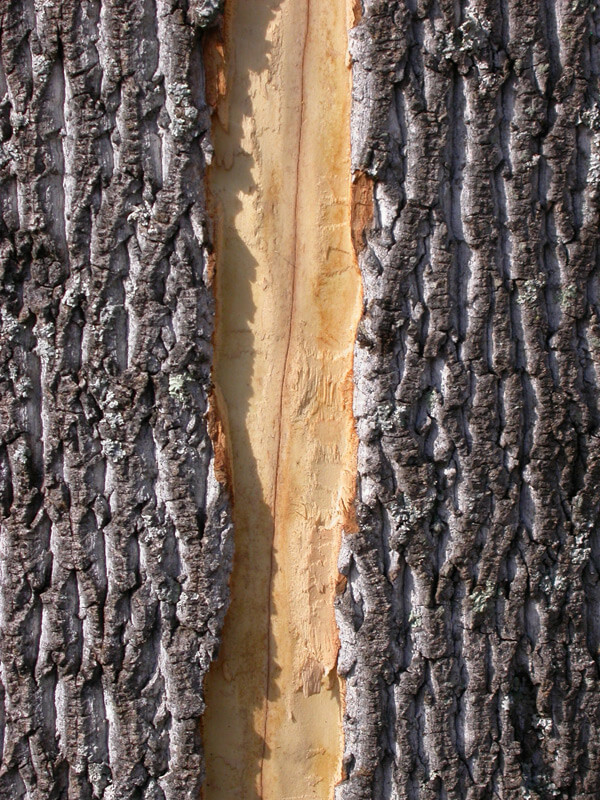
    Generally, the first major sign that EAB has infested a tree is a thinning of leaves at the top of the tree. Unfortunately, if you see this symptom, your tree will likely have been under attack for some time already. Other signs to look for include the following:

    • Yellowing of leaves
    • Epicormic shoots
    • D-shaped exit holes
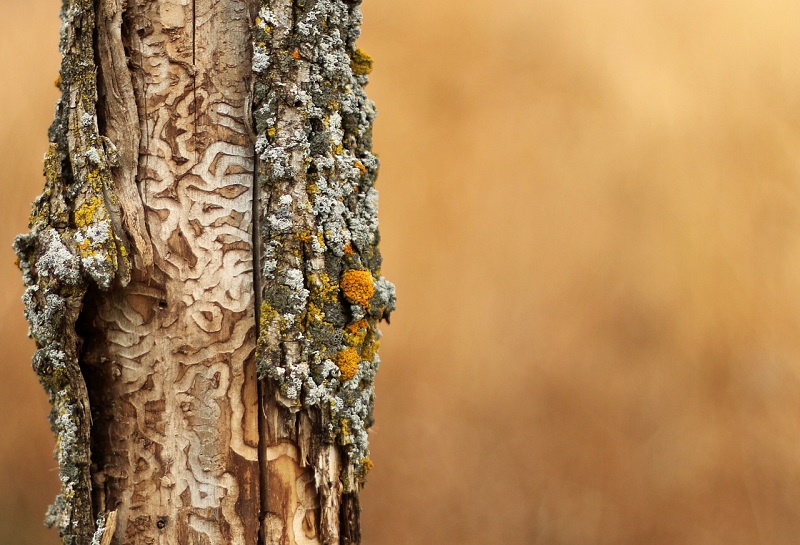
    • S-shaped galleries under the bark
    • Unusual woodpecker activity

    Emerald ash borer s shaped galleries - emerald ash borer inspection - Stein Tree Service Wilmington DE

    Remove Debris & Tree Wrappings

    Regular fall and winter seasons will cause leaves to cover the areas around the base of your trees. After the winter season we have just encountered, you may find larger branches that need to be removed. Rake or pick up leaves, twigs, or other debris around your trees.

    Also, remove any protective wraps you have used during the winter and ensure that no roots or other items are wrapped around the trees. Leaving the tree constricted in any way can cause girdling, which cuts off the flow of nutrients and water and can weaken the tree trunk.

    Add Fresh Mulch

    In addition to giving a fresh look to your landscape, mulch can be a healthy addition. Adding a 3-inch layer of mulch around trees helps retain moisture and discourages weed growth. Be careful to avoid mulching too close to the tree. If mulch piles against the tree, fungi are more likely to develop, so make sure the mulch is all around the tree but just shy of touching the tree.

    Trim and Prune

    Though winter is the best time for pruning, trees may remain dormant in spring, allowing for late trimming and pruning. Remember that in Pennsylvania and Delaware, windy conditions and storms are common in the spring and summer, so thinning out branches will reduce the potential for weak branches to fall off and cause damage to surrounding property. Pruning trees and shrubs can help with overall air flow and also encourage healthy growth.

    However, pruning requires the right knowledge and experience, as improper or incorrect cuts can lead to adverse outcomes, like over-pruning or improperly pruning, damaging the appearance or overall health of the trees. As a result, hiring a professional to do this type of pruning is recommended.

    General Inspection Tips

    In addition to our specific recommendations, here is some general advice when looking at your landscape in the spring.

    • Inspect all elements of your landscape to prepare for the summer.
    • Ensure irrigation systems are working properly and set to avoid spraying on trees susceptible to fungus.
    • Check for any damage that may have occurred. If tree limbs are weak, those branches may be susceptible to breakage, which could cause property damage. Damage to bark could also leave trees open to infection or insect infestation.
    • Look for the presence of fungus or other tree disease. Mushrooms growing on tree surfaces could indicate tree death, weakening the tree trunk and necessitating removal.

    Call Stein Tree for Spring Tree Care and Emerald Ash Borer Inspection

    Maintaining your landscape should be essential to your home spring cleaning routine. Stein Tree Service has provided excellent tree care, including tree removal, trimming and pruning, emerald ash borer inspection, and other services, to the residents of Delaware, Pennsylvania, and Maryland for over 40 years. We are also licensed to treat the emerald ash borer pest in Delaware and Pennsylvania. Contact us today for a free consultation or to learn about our services!

    REQUEST A FREE, NO OBLIGATION CONSULTATION

    Featured Programs

    Inspect for Emerald Ash Borer infestation - Stein Tree Service - 1000

    Spotted Lanternfly Quarantine Areas

    Stein has a permit to work in spotted lanternfly quarantine areas in Pennsylvania and Delaware. Tree Service Companies have to be trained in proper moving and disposal of materials to avoid spread of the spotted lanternfly and Stein has completed the training courses.

    Read more

    Inspect for Emerald Ash Borer infestation - Stein Tree Service - 1000

    Emerald Ash Borer Inspection

    In the spring, destructive ash borer (EAB) adult beetles begin to emerge.  These invasive pests can destroy your ash trees.  Our specialists are certified to treat for EAP in Pennsylvania and Delaware.  For A free consultation, contact us today.

    Read more

    Continue reading

    Stein Tree Lift Truck - Tree Trimming in Talleyville DE

    How Old Should A Tree Be Before Pruning and Other Tree Trimming and Pruning Questions

    Tree trimming and pruning are essential for tree health on a residential or commercial property. While trees in a forest may die without anyone noticing due to overgrowth or infections, in our neighborhoods, the health of trees has a significant and noticeable impact. A diseased branch could fall and harm our property or persons. A canopy that is too crowded can cause fungi to develop, harming the health and aesthetics of an area. Overgrown trees can also lower visibility from the street. Below, Stein discusses how old should a tree be before pruning and other frequently asked tree care questions.

    Three Frequently Asked Tree Care Questions

    With tree trimming and pruning in Wilmington, DE, being so necessary, we get many questions about the basics, such as how old should a tree be before pruning. The following are a few of the more frequently asked questions, their answers, and information about how our team can help improve the health and aesthetics of your yard.

    How Old Should a Tree be Before Pruning?

    Early and proper pruning is one of the most important aspects of tree care. Pruning young trees by removing broken or damaged branches helps prevent future issues. That said, over-pruning is just as bad as under-pruning. Young trees will require minimal pruning in their first two years, and a professional tree care service can ensure the tree matures appropriately.

    However, if you have newly planted or transplanted a tree, limit pruning to only removing dead or broken branches. Full pruning, shaping, and trimming should wait until the second or third year when the tree fully recovers from the stress of being moved.

    As mentioned, corrective pruning early on in a tree’s life cycle can prevent health issues as the tree grows and becomes mature. In addition, a mature tree pruned appropriately early in its lifespan will more likely have a strong branch structure, and the large limbs will not obscure streets or walkways or pose a danger to passersby.

    What Are the Risks of Pruning a Mature Tree?

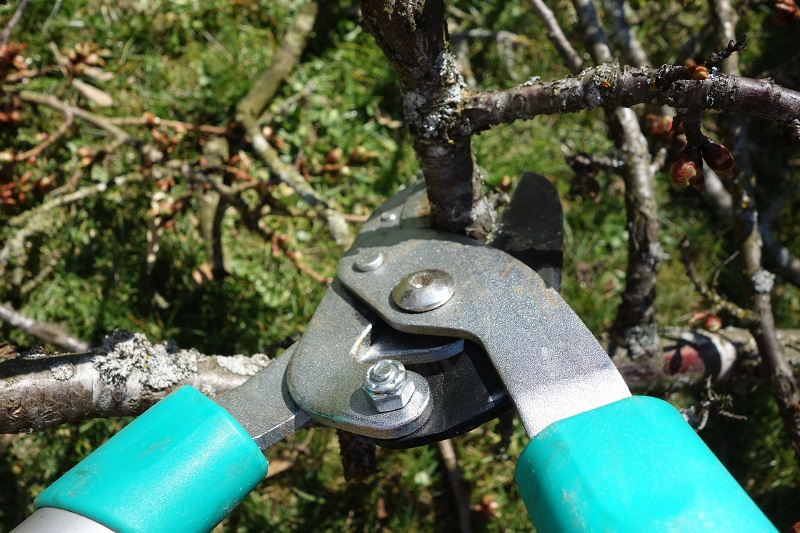
    Pruning-shears being used on tree | how old should a tree be before pruning | Stein Tree Service

    While pruning can benefit mature trees, risks are involved, especially if done incorrectly. Here are some of the critical risks to be aware of:

    Over-pruning can be harmful to trees and can lead to the following issues:

    • Reduced energy: Trees require their leaves for energy production through photosynthesis.
    • Weakened branches: Improper pruning cuts lead to weak branches prone to breakage.
    • Increased risk of tipping: Removing lower branches makes the tree top-heavy, which increases the risk of tipping.
    • Sunscald: Direct sunlight on the previously shaded trunk can cause sunscald.
    • Increased risk of disease: Large pruning wounds create entry points for pathogens and insects.

    Improper pruning techniques can have the following adverse effects on trees:

    • Flush cuts are cuts too close to the trunk that remove the branch collar, the natural barrier that helps the tree heal wounds and prevent decay.
    • Tree topping is the practice of cutting off large branches at the top, disrupting the tree’s natural structure, weakening it significantly, and encouraging weak, fast-growing suckers that are prone to breaking.
    • Dull or unsterilized tools can lead to uneven cuts, tearing bark, and spreading diseases.

    Other risks of pruning a mature tree via DIY methods or without the proper tools, knowledge, and experience can lead to the following issues:

    • Injury to the person pruning: Working with sharp tools and climbing trees requires proper safety gear and techniques.
    • Property damage: Falling branches or equipment can damage structures or injure people nearby.

    Remember, mature trees are valuable assets, and pruning should be done carefully. Consulting a professional arborist can help you make informed decisions about your tree’s health.

    What Are Water Sprouts and What Causes Them?

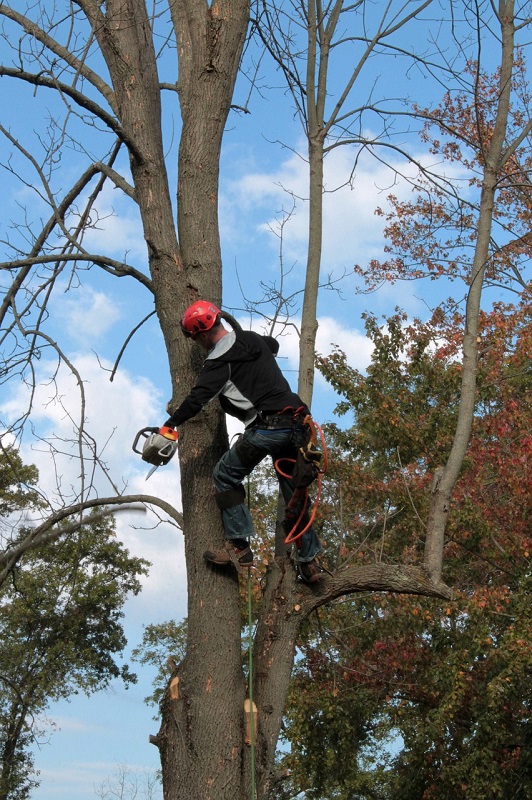
    Man climbing tree for trimming | how old should a tree be before pruning | Stein Tree Service

    Water sprouts are shoots from a tree’s trunk, branches, or latent buds. Some people confuse them with “suckers,” which are shoots that grow from roots or bases.

    Another difference between water sprouts and suckers is the growth pattern. Water sprouts grow rapidly and vertically but do not bear flowers or fruit and can reduce airflow and light. Suckers grow slantingly or horizontally and might bear different flowers or fruit depending on the rootstock.

    These water sprouts grow fast and often appear due to cuts that remove a branch bud tip. Tree topping, removing branches above a certain height, is an unhealthy practice that frequently leads to the formation of water sprouts. These sprouts are less than ideal aesthetically and can sap energy away from the rest of the tree.

    When Should I Prune?

    In addition to knowing how old should a tree be before pruning, homeowners often wonder what the right time to prune is. The best time to prune will depend upon the type of trees you have and the desired outcome of tree trimming and pruning in your Wilmington, DE neighborhood.

    In general, pruning during winter dormancy is ideal as the risk of infection is reduced and the practice encourages new early spring growth. The lack of leaves during winter also helps tree care specialists identify which branches need pruning and allows for better pruning cuts. However, other times are appropriate if the pruning is performed correctly. A professional, qualified tree care service will advise you on safe times for trimming your trees and shrubs.

    Are There Any Tree Species That Require Early Pruning?

    Some tree species require pruning at an earlier age than others. This early pruning ensures proper growth patterns, removes potentially hazardous limbs, encourages a strong structure, and improves the tree’s overall health. Here are a few examples:

    1. Fruit Trees (e.g., apple, peach, cherry): Pruning is crucial for young fruit trees to support fruit production. This typically starts 1-2 years after planting.
    2. Ornamental Trees (e.g., Japanese Maple, Crepe Myrtle): These trees may require early pruning to shape the tree aesthetically. Pruning can begin within the first few years after planting.
    3. Fast-Growing Shade Trees (e.g., Silver Maple, Willow): These can quickly develop weak wood and poor branch structures, necessitating early pruning to remove competing leaders and weak limbs.
    4. Conifers (e.g., Pine, Spruce): While many conifers require minimal pruning, some may need early pruning to remove dead or diseased branches or to shape the tree for landscape purposes.

    The pruning process can differ widely based on the tree species, condition, location, and purpose. Seeking professional advice from an arborist or can provide tailored guidance for particular trees and climates.

    Stein Tree Service Offers Skilled Tree Trimming and Pruning in Wilmington, DE

    Have more questions about how old should a tree be before pruning? Our experienced certified arborists and tree care specialists are dedicated to exceptional tree care, and we offer free consultations in Delaware and Pennsylvania. Contact us at Stein Tree Service to learn more about the best tree trimming and pruning practices in Wilmington, DE, and surrounding areas.

    REQUEST A FREE, NO OBLIGATION CONSULTATION

    Featured Programs

    Inspect for Emerald Ash Borer infestation - Stein Tree Service - 1000

    Spotted Lanternfly Quarantine Areas

    Stein has a permit to work in spotted lanternfly quarantine areas in Pennsylvania and Delaware. Tree Service Companies have to be trained in proper moving and disposal of materials to avoid spread of the spotted lanternfly and Stein has completed the training courses.

    Read more

    Inspect for Emerald Ash Borer infestation - Stein Tree Service - 1000

    Emerald Ash Borer Inspection

    In the spring, destructive ash borer (EAB) adult beetles begin to emerge.  These invasive pests can destroy your ash trees.  Our specialists are certified to treat for EAP in Pennsylvania and Delaware.  For A free consultation, contact us today.

    Read more

    Continue reading

    Tree removal and tree stump removal by tree care specialist with saw- Stein

    Stein Answers Frequently Asked Tree Removal Questions

    Trees are beautiful, provide shade, clean the air, and provide homes for all types of wildlife. In addition, trees can have a high sentimental value to us, having been a fixture in our great-grandparents’ homes or planted to commemorate a special event. In these types of cases, no one wants to consider tree removal. However, sometimes hiring a tree removal company is necessary to prevent damage to your property and for residents’ safety. To help homeowners by providing you with the knowledge to make informed decisions about your trees, Stein answers some of our frequently asked tree removal questions.

    Do I Have to Get Rid of My Tree?

    Sometimes, you pass a yard and see wide-trunked and towering beauties in a yard that rise a hundred feet over a home or other structure. Though these trees are impressive, are they safe? A certified arborist or other tree care specialist can determine whether a tree is at risk for falling even if no blatant signs exist. The specialist will evaluate the visible signs, like dead branches, fungal growth, dieback, or insect infestation. They will perform other tests to determine if the tree is still viable or if cavities create vulnerability.

    Learn More About Tall Trees Near Homes

    When is the Best Time for Tree Removal?

    One of the frequent tree removal questions we get is when is the ideal time for removing trees. While tree removal can be done all year, late winter and early spring are ideal times for tree removal. One reason is that most trees will have bare branches, which makes it easier for a tree service company to inspect and remove them. That improved visibility is critical if a tree is near other structures, like a house or power lines.

    What Will Happen to The Stump?

    Homeowners who have to get a tree removed from their yards are often concerned about the stump. Specifically, people are worried about the conditions of their landscape when a tree is removed. Of course, a homeowner can leave the stump in the yard, but many reasons exist for removing them.

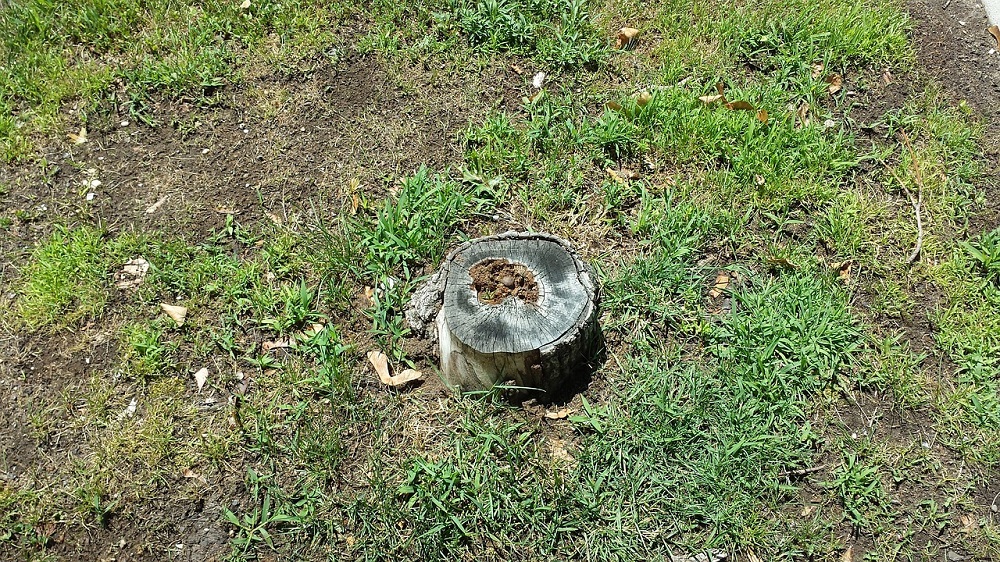
    Leaving a tree stump in your yard can pose several risks, including creating a tripping hazard, damaging equipment, and allowing root growth. Tree stumps can also attract pests, look unsightly, restrict planting space, and reduce property value. Therefore, removing the stump after tree removal is recommended, especially in a high-traffic area.

    Professional tree care companies use different methods to remove the stump. For example, Stein Tree Service uses a stump grinder to grind the tree stump into small chips. After stump grinding, our team can use these chips to fill the hole, or we can haul them away. Either way, we can entirely remove the tree in almost all cases.

    stump after tree removal | Frequently asked tree removal questions | Stein Tree Service

    Why Do You Need Stump Removal?

    Can I Have a Tree Removed if The Space is Small?

    Homeowners with small yards or homes close to other homes worry that felling a tree could endanger the property or people nearby. For an inexperienced person, this is a genuine concern. However, a professional should do the job whenever a tree is removed, especially a large one. And in a tight space, having the knowledge and skill to make the precise cuts necessary is even more vital. Stein Tree Service has the equipment and skill to remove trees from any area. In fact, we recently removed one from behind some rowhouses in Wilmington, where the only access was through a small tunnel. We are also insured, so homeowners and specialists have protection if an accident should occur.

    Learn About Removing Trees From Confined Spaces

    What Are Some Specific Signs That a Tree Is at Risk for Falling?

    Determining whether a tree is at risk for falling or poses a potential hazard requires careful observation and assessment. Several signs indicate a tree’s structural integrity is compromised, making it more susceptible to failure.

    One such sign is the absence or scarcity of leaves on the tree. An ordinarily leafy tree that suddenly shows little to no foliage could indicate underlying issues with its health or stability. Discolored leaves, especially if they appear wilted or brown, can also mean stress or disease within the tree.

    The condition of the bark can provide valuable insights into a tree’s overall health. If you notice large patches of bark falling off or the bark appearing dry, the tree may suffer from environmental stress, fungal diseases, or insect diseases. As a result, you should reach out to a tree specialist for a comprehensive evaluation of your tree’s health.

    Can I Just Cut Off the Top?

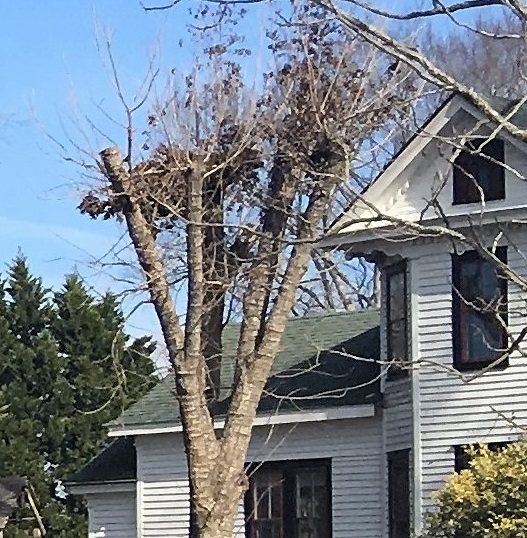
    If trees are planted in a space that is insufficient for their mature size, they may have to be removed to avoid contact with homes or power lines. Homeowners often ask if we can just cut down trees to fit the space. This practice is called tree topping and is very detrimental to the tree.

    What Are the Dangers of Tree Topping?

    One of the dangers of tree topping is weakening of the tree. When you remove the top portion of a tree, you remove the primary source of nutrients and energy. This can leave the tree vulnerable to disease, insect infestation, and other environmental stresses. In addition, the many open wounds created by tree topping provide entry points for pests and pathogens to enter the tree. A certified arborist or tree care professional can advise homeowners of the best action if a tree has outgrown its space.

    Learn More About Tree Topping

    topped tree beside a home- Frequently Asked Tree Removal Questions |Stein Tree Service

    Stein Tree Service Provides Skilled Tree Removal in Delaware and Pennsylvania

    Stein’s and skilled tree care specialists are committed to excellent tree care and answering your tree removal questions. In addition, our company has liability insurance to protect you and your property. If you have questions about your trees and their proper care, we can help. We will evaluate the trees in your landscape and recommend the best solution, which could include tree removal. On the other hand, your tree may only need careful trimming and pruning or other special care. Contact Stein for a free consultation.

    REQUEST A FREE, NO OBLIGATION CONSULTATION

    Featured Programs

    Inspect for Emerald Ash Borer infestation - Stein Tree Service - 1000

    Spotted Lanternfly Quarantine Areas

    Stein has a permit to work in spotted lanternfly quarantine areas in Pennsylvania and Delaware. Tree Service Companies have to be trained in proper moving and disposal of materials to avoid spread of the spotted lanternfly and Stein has completed the training courses.

    Read more

    Inspect for Emerald Ash Borer infestation - Stein Tree Service - 1000

    Emerald Ash Borer Inspection

    In the spring, destructive ash borer (EAB) adult beetles begin to emerge.  These invasive pests can destroy your ash trees.  Our specialists are certified to treat for EAP in Pennsylvania and Delaware.  For A free consultation, contact us today.

    Read more

    Continue reading

    Ice covered tree in winter - Winter tree removal in Wilmington DE by Stein Tree Service

    Is Winter Tree Removal in Wilmington DE Possible?

    The short answer is yes. Winter is a great time to contact a professional tree care company like Stein Tree Service for tree removal in Wilmington DE. Removal before or during winter is essential to consider for diseased or dead trees, as the last thing homeowners want is a bad winter storm, knocking a problem tree or branches down onto their homes, vehicles, or other property.

    Why Winter is the Best Time for Removing Trees in Wilmington

    Winterizing trees is about the health of the trees and preventing costly damage. This is because, during this time of year, trees enter into a dormant state. Dormancy in trees is when the tree is alive but not actively growing. During this time, the inner workings of a tree slow down and pause until conditions change to allow for productive growth. As a result, dormant trees are less susceptible to stress and disease.

    Removing a diseased or dead tree during winter can also prevent the tree from falling during a winter storm, which can cause costly damage to homes, vehicles, and other property. Of course, such property protection is only one reason tree removal during winter is advisable. Consider other reasons why winter is a great time to call Stein Tree Service for tree removal in Wilmington, DE.

    Quiet Season

    The winter season is a slow season both for professional arborists and for your own family. During winter’s cold days, your family, neighbors, and other pedestrians will likely limit their time outdoors. Less foot and equipment traffic in yards will mean fewer obstacles, allowing small and large tree removal be done more quickly and with less interruption of daily activities.

    Additionally, most trees, shrubs, and other flowering plants require reduced maintenance when entering dormancy. Therefore, professional tree services like ours have reduced responsibilities and can offer more competitive prices for tree removal.

    Easier Access and Reduced Property Impact

    Many new property owners assume that the frozen ground can make tree removal hard and near impossible, but quite the opposite is true. Frozen soil and grass create the perfect conditions for tree removal in Wilmington DE. Such conditions make bringing heavier equipment onto a property easier, like cranes that may be necessary for older and larger tree removals, i.e., oak species.

    The winter season is also an ideal time to remove trees without causing harm to other plants in the area. When we remove a tree, we can, in most cases, also remove the roots from the soil. During the winter season, the frozen ground makes removing the tree and root system easier without causing damage to other plants.

    After the tree is removed, the soil and the area around where the tree was located will recover. The roots of the nearby plants will have more room to grow, and the soil will be able to retain more moisture. As a result, when spring arrives, the grass and other plants in the area will enjoy new growth and thrive without being negatively impacted by the tree removal process.

    Contact Stein Tree Service to Learn More about Winter Tree Removal in Wilmington DE

    Do you have a tree that you are worried about? Contact our skilled arborists and tree care specialists at Stein Tree Service for a free inspection. Our skilled team will professionally assess the situation and help you determine whether winter tree removal in Wilmington DE is necessary.

    REQUEST A FREE, NO OBLIGATION CONSULTATION

    Featured Programs

    Inspect for Emerald Ash Borer infestation - Stein Tree Service - 1000

    Spotted Lanternfly Quarantine Areas

    Stein has a permit to work in spotted lanternfly quarantine areas in Pennsylvania and Delaware. Tree Service Companies have to be trained in proper moving and disposal of materials to avoid spread of the spotted lanternfly and Stein has completed the training courses.

    Read more

    Inspect for Emerald Ash Borer infestation - Stein Tree Service - 1000

    Emerald Ash Borer Inspection

    In the spring, destructive ash borer (EAB) adult beetles begin to emerge.  These invasive pests can destroy your ash trees.  Our specialists are certified to treat for EAP in Pennsylvania and Delaware.  For A free consultation, contact us today.

    Read more

    Continue reading

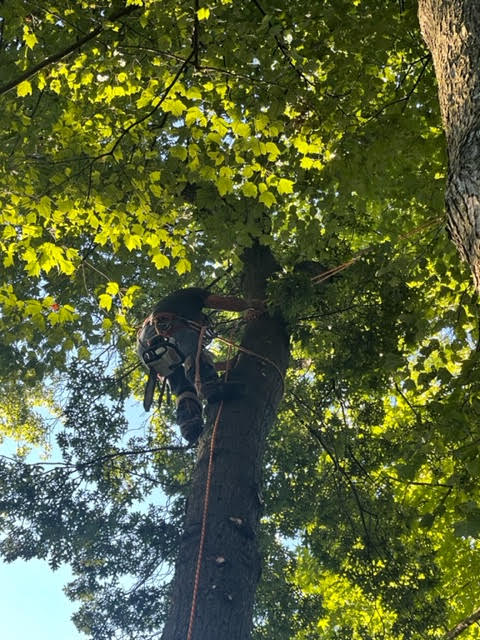
    Man Climbing To Remove Tree Near Power Lines | Tree removal services in Elsmere Delaware | Stein Tree Service

    Tree Removal in Confined Spaces

    Homeowners residing in homes with small yards or homes near other residential properties often worry about trees falling on surrounding individuals and assets. Such concerns are especially valid for those who lack experience in the field. To avoid these issues with tree removal in confined spaces, employ the services of a professional when removing a tree. In confined spaces, precise cuts are vital and require specific skills and knowledge.

    If you have a tree in a confined space and want to ensure you and your property are safe, contact a professional tree service company with the right equipment and know-how to efficiently handle tree removal in narrow or difficult-to-reach areas. Professionals do the job with a keen sense of safety, ensuring their crew’s and surroundings’ safety.

    See Our FAQs About Tree Removal

    What Constitutes a Confined Space?

    A confined space in tree removal refers to any site that is difficult for crews and equipment to access. Walking the tightrope of confined spaces becomes even more critical when dealing with foot traffic or the risk of damaging surrounding property.

    Common examples of these confined spaces include narrow gaps between buildings, easements between structures and the street, areas near power lines, terraced yards, and spaces that equipment like our spider lift or a stump grinder may be unable to pass into.

    When Tree Removal in Confined Spaces is Necessary

    Some situations make tree removal in confined spaces necessary to consider. Some examples include the following:

    • Branches start rubbing against structures, creating potential property damage
    • The tree receives substantial damage
    • The tree is leaning precariously, threatening nearby structures
    • Broad trees with dense foliage are causing debris problems
    • Tree branches are in danger of contact with power lines

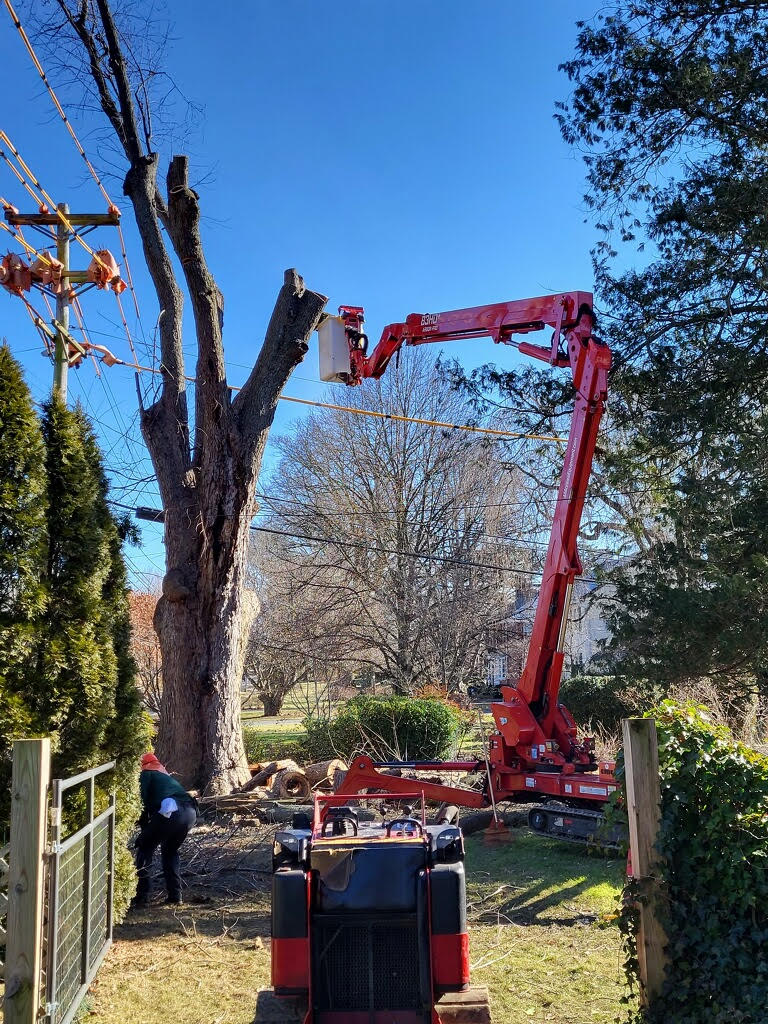
    Spider lift and skid steer being used to cut down a tall tree near power lines - tree removal in confined spaces - Stein Tree Service

    How to Remove a Tree in a Confined Space

    Tree removal in a confined space varies according to the situation. One of the approaches we use for tree removal in confined spaces involves using a spider lift. The spider lift is compact enough to be positioned in many small areas. Tree care and removal specialists are safely lifted to remove branches, then remove a section of the trunk at a time. If even the spider lift is unable to be moved into the space, our specialists are trained to climb using harnesses and cables. Either way, the tree is cut down in sections, starting from the top and working downwards. First, branches are removed, then the trunk is cut into smaller sections, usually with ropes or a speedline to guide its descent and ensure the pieces fall in a safe direction. Every member of the team is aware at all times of their location in relation to the work being performed in order to avoid accidents.

    Tree removal is a complex and often dangerous operation that requires specialized tools and training. Attempting to remove a tree without the proper equipment and knowledge can lead to severe injury or even fatalities. Therefore, make sure that you have a fully licensed and insured professional tree removal company to ensure the job is done safely and efficiently. In addition to their training and experience, a professional will have the specialized equipment required to remove trees from confined spaces. These may include tools such as cranes, grapple saws, chippers, and log trucks, each serving a specific purpose in tree removal.

    Recent Tree Removal Job in Inner City Wilmington, DE

    We recently did a challenging tree removal job in Inner City Wilmington where the only access available to us was through a 30-40 foot long tunnel. Local residents may already be familiar with the layout of yards in the rowhouses in Inner City Wilmington. If the house is not on the end of the block, the homeowner is required by the city to have a second way out in case of fire. Sometimes there is a 2-3 foot wide walkway in between the yards that run the whole length of the block. If that is not the case for whatever reason, like if the house is on a hill with a big retaining wall, the second form of egress is the tunnel out to the front.

    Homeowners in this situation may have the front door that is often 6 steps above the sidewalk level, and then the back door goes into a 20×20 ft fenced in yard with no way out in case of a fire. The way they would have to get out is through the tunnel: down under the house and then back out front again. That’s the only way into and out of the back yard except through the house,

    and homeowners would prefer we take the tree out through the tunnel than through the house. In this situation, our team went through the long tunnel, and since the spider lift was unable to fit, they climbed the tree and just had to cut small enough pieces to fit through that little tunnel.

    Crane Limitations

    As in the case of the rowhouses, some trees that need to be removed are in very confined spaces where a crane or lift are unable to go or even reach from outside the area. In cities, one of the challenges with the crane is the spiderweb of wires overhead. The crane might be able to put its boom straight up between the wires, but to actually swing around and maneuver a tree is another story. For example, if we could get a crane into a space like this, the crane may have to reach over the house 100 feet to tie into the tree, then we do the cuts and pick the pieces up. The crane still needs 50-80 feet of arm swing in a radius to bring it back down to the street.

    When we say spiderweb of wires, we mean the situation would really make you think of spiderwebs. Consider how a rowhome set up could be. A block may have 4 telephone poles: one on each corner and 2 in the middle of the block, one a third of the way, a second 2/3 away and the other at the other end of the block. The wires that feed the houses come off each pole then fan out to 4-5 houses each. So we really have a spiderweb of wires above our heads.

    Contact Stein Tree Service for Tree Removal

    These types of jobs have a higher level of difficulty and take longer to complete. They require help from a tree service company that has professionals who can climb trees and cut the tree into small enough pieces for them to carry out of the yard to the chipper. Some companies are unable to do this type of job because they have no climbers, but at Stein, we are equipped with the tools and the staff to perform tree removal in confined spaces. We are also insured, so homeowners and specialists have protection if an accident should occur. Contact us today for a free consultation.

    REQUEST A FREE, NO OBLIGATION CONSULTATION

    Featured Programs

    Inspect for Emerald Ash Borer infestation - Stein Tree Service - 1000

    Spotted Lanternfly Quarantine Areas

    Stein has a permit to work in spotted lanternfly quarantine areas in Pennsylvania and Delaware. Tree Service Companies have to be trained in proper moving and disposal of materials to avoid spread of the spotted lanternfly and Stein has completed the training courses.

    Read more

    Inspect for Emerald Ash Borer infestation - Stein Tree Service - 1000

    Emerald Ash Borer Inspection

    In the spring, destructive ash borer (EAB) adult beetles begin to emerge.  These invasive pests can destroy your ash trees.  Our specialists are certified to treat for EAP in Pennsylvania and Delaware.  For A free consultation, contact us today.

    Read more

    Continue reading

    Man in compact spider lift using arborist saw on a tall tree - tree removal and tree trimming and pruning - Stein Tree Service

    Will Insurance Pay for Hazardous Tree Removal in Wilmington, DE?

    We all love our trees. From branching maples and red oaks to colorful dogwoods, trees provide myriad benefits and improve the look and feel of a property. However, even the hardiest tree can fall victim to disease and old age, and what once was a beautiful addition to your property may now be a hazardous object. If you have a dead, dying, or dangerously placed tree, you may be wondering about hazardous tree removal in Wilmington, DE, and whether your homeowner’s insurance will pay for the service.

    Insurance Guidelines for Tree Removal in Wilmington, DE

    As Delaware and Pennsylvania residents and property owners prepare for winter storms, where vulnerable trees could fall, the worry about those trees may be in the forefront of their minds. In general, most homeowners insurance companies are unwilling to pay to have a dead or dying tree removed from a property unless the tree has already fallen and caused damage. Even then, they may only pay for part of the costs.

    Why You Should Avoid Waiting

    Homeowners should avoid waiting for nature to take its course with hazardous trees. Waiting for dangerous trees to fall on their own may save you some removal costs, but waiting is a dangerous game as a falling tree can seriously injure people and pets or cause massive, expensive damage to property that can take a long time to repair. Injuries due to a lack of tree maintenance are worrisome, as you are likely to become legally liable if a tree injures a neighbor or damages their property.

    For example, if a homeowner has a tree with an overhanging branch that has been dead for years, but the homeowner has neglected to remove it despite complaints from neighbors, and that branch falls onto the neighbor’s property or injures them, the homeowner can be held liable.

    These liabilities and legal disputes can cost people thousands of dollars, even tens of thousands of dollars, depending on the damage, while the damage itself could have been prevented with proper tree care.

    Insurance Guidelines for Tree Removal in Wilmington

    Therefore, the best advice for Wilmington and surrounding Delaware residents is to have any suspicious-looking trees properly inspected by a certified arborist as soon as possible. Tree trimming and the removal of dangerous trees are considered by insurance policies to be a part of routine homeowner maintenance. In some cases, our team may be able to trim back or prune away parts of a diseased or overgrown tree to reduce the risk of harm to people or property. In cases where emergency tree removal in Wilmington, DE, is necessary, Stein Tree Service is available 24/7 and responds quickly.

    What Constitutes a Hazardous Tree?

    A hazardous tree for property owners is one that is likely to fall or shed branches, causing damage to property or people. This can be due to a number of factors, including:

    • Dead or diseased trees: Dead and diseased trees are likelier to fall or shed branches than healthy trees.
    • Trees with structural defects: Trees with structural defects, such as cracks in the trunk or limbs or rot in the roots, are also more likely to fail.
    • Trees that have been damaged by storms or other events: Trees that have been damaged by storms, fires, or other events may be more likely to fall or drop branches.
    • Trees that are leaning or growing too close to buildings, power lines, or other structures: Trees that are leaning or growing too close to buildings, power lines, or other structures pose a hazard and can cause damage.

    Here are some specific signs that a tree may be hazardous:

    • Dead or diseased branches
    • Cracks in the trunk or limbs
    • Rot in the roots
    • Leaning trunk
    • Tree growing too close to buildings, power lines, or other structures
    • The tree has been damaged by storms or other events

    While these signs are generally what hazardous trees display, each tree and environment is unique. What constitutes a hazard will vary depending on the specific tree and its surroundings. For example, a tree that is healthy and structurally sound may still pose a hazard if that tree is growing too close to a house.

    Understanding the Risks of a Hazardous Tree

    Understanding the risks associated with hazardous trees is crucial for proper tree care and safety on both public and private property. These risks can arise from factors such as unstable tree limbs, fire damage, storm damage, or even tree death due to disease or old age.

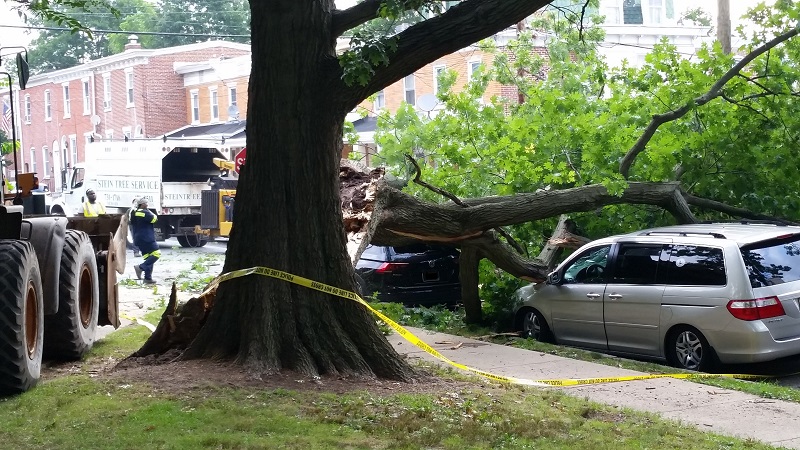
    Falling tree limbs can pose a range of potential dangers. First, there is the risk of injury or even death to individuals nearby. A falling tree limb can cause severe trauma and even fatalities if branches land on a person. Additionally, falling tree limbs can cause damage to vehicles, structures, and other personal property, resulting in costly repairs or replacements.

    Regarding public safety, falling tree limbs can create hazardous conditions. Tree limbs can obstruct roads and sidewalks, potentially causing accidents for pedestrians and road users. In addition, falling tree limbs can also damage power lines, leading to power outages and posing a significant risk of electrical fires.

    For property owners adjacent to trees, there is a constant risk of falling tree limbs. Strong winds and storms can weaken tree branches, making them more prone to falling. This can threaten the safety of persons and their personal property, including structures, vehicles, and outdoor amenities.

    Why You Should Avoid Waiting

    Homeowners should avoid waiting for nature to take its course with hazardous trees. Waiting for dangerous trees to fall on their own may save you some removal costs, but waiting is a dangerous game as a falling tree can seriously injure people and pets or cause massive, expensive damage to property that can take a long time to repair. Injuries due to a lack of tree maintenance are worrisome, as you are likely to become legally liable if a tree injures a neighbor or damages their property.

    For example, if a homeowner has a tree with an overhanging branch that has been dead for years, but the homeowner has neglected to remove it despite complaints from neighbors, and that branch falls onto the neighbor’s property or injures them, the homeowner can be held liable.

    These liabilities and legal disputes can cost people thousands of dollars, even tens of thousands of dollars, depending on the damage, while the damage itself could have been prevented with proper tree care.

    Contact Stein Tree Service for Emergency Tree Removal in Wilmington, DE

    Diseased and dying trees can have catastrophic impacts should they fall on your property. If you are unsure about the health and well-being of any tree on your property, contact us for an inspection by a certified arborist. Our team is skilled in various tree care services, from the mitigation of hazardous trees via bracing or pruning to the complete removal of dead or dying plant life via tree removal and stump grinding. Our hazardous tree removal services could save you thousands in the event of a need for emergency tree removal.

    REQUEST A FREE, NO OBLIGATION CONSULTATION

    Featured Programs

    Inspect for Emerald Ash Borer infestation - Stein Tree Service - 1000

    Spotted Lanternfly Quarantine Areas

    Stein has a permit to work in spotted lanternfly quarantine areas in Pennsylvania and Delaware. Tree Service Companies have to be trained in proper moving and disposal of materials to avoid spread of the spotted lanternfly and Stein has completed the training courses.

    Read more

    Inspect for Emerald Ash Borer infestation - Stein Tree Service - 1000

    Emerald Ash Borer Inspection

    In the spring, destructive ash borer (EAB) adult beetles begin to emerge.  These invasive pests can destroy your ash trees.  Our specialists are certified to treat for EAB in Pennsylvania and Delaware.  For A free consultation, contact us today.
    Read more

    Continue reading

    tree branch with yellow leaf, fall and winter are the best times for tree trimming, stein tree service

    4 Tips to Prepare Trees for Winter

    The weather will soon get colder, so the time to prepare trees for winter is near. Your trees can risk being damaged during winter, especially during winds or snow and ice. Take care of your trees before winter, and help them withstand the cold weather better. And a few specific methods, such as watering, pruning, and wrapping, can keep your trees healthy and ready to bloom next spring. Stein offers a few tips to help prepare your trees for winter.

    Why You Should Prepare Trees for Winter

    With winter comes risks to your trees’ health and safety. The cold temperatures can cause stress and damage to tree roots and tissues. Strong winds and storms can break off branches and damage the surroundings. At the same time, snow and ice can add unexpected weight, potentially causing branches to snap. Even the sun and radiant heat can cause issues.

    All these factors contribute to a challenging season for trees, making winter preparedness vital to minimize harm and preserve tree health. Below are 6 tips to help your trees during the winter season.

    See Our Tree Trimming & Pruning Services

    1. Tree Inspections

    Winter is coming, and there is no better time to inspect your trees. Just like an annual health check-up is advisable for you, regular inspections are essential for the welfare of your trees. Inspections enable early detection and treatment of any existing or potential issues and assist in preparing the trees to withstand the harsh winter.

    An experienced arborist can comprehensively evaluate tree health, assessing risk factors such as damaged limbs, signs of disease, pest infestation, or structural instability. Keeping your trees in check and taking proactive measures can enhance their winter readiness.

    2. Water

    Watering is one of the essential ways homeowners can prepare trees for winter. Water helps provide nutrients to trees and acts as an insulator, protecting the tree’s cells from cold weather damage. If the soil beneath a tree has adequate water, the soil stays warmer during the winter. Newly planted or young trees are even more susceptible to winter damage, so providing enough water before the ground freezes is especially important. Ensuring that your trees have had enough water before the cold weather kicks in will go a long way to keeping them healthy during winter.

    3. Trimming & Pruning

    Once fall is in full effect and after your trees have gone dormant, pruning and trimming will prepare them for the cold winter. Trimming and pruning trees before the winter minimize potential damage during winter winds or heavy snow. When trees lose their leaves in the late fall and early winter, identifying and removing unsafe branches is significantly easier.

    Any wounds from trimming and pruning will heal more quickly since the tree is expending no energy on new growth, so the tree will be less likely to become infected by disease or insects. So to better prepare trees for winter and keep them healthy and your property safer, contact your arborist for pruning and trimming services.

    4. Reflective Tree Wraps

    Although cold damage is most common during winter, tree bark can also get damaged from the bright sun, which a reflective tree wrap can alleviate. When the winter sun shines directly onto and warms a tree trunk, the heat triggers a growth response, which results in new growth tissues that are susceptible to damage (called “sun scald”) once the temperature drops. Tree wraps work by reflecting sunlight, thereby preventing the tree trunk from absorbing excessive heat. The resultant controlled temperature inhibits that unexpected growth response in trees.

    While reflective tree wraps can benefit certain species, tree-wrapping practices vary based on species, location, and tree health. Check with your arborist to see if this method is recommended for your trees.

    5. Mulch

    Many people think of mulch in the spring, but at any time of year, mulch can help prevent moisture loss from the soil and regulate soil temperatures. Add a thick layer beneath the tree’s drip line in late fall or early winter.

    6. Stump or Tree Removal

    Sometimes, despite all efforts, a tree or stump must be removed. Removal might be necessary if a tree is dead, in severe decline, disease-infested beyond recovery, or posing a risk to the surroundings. Winter storms could exacerbate weak conditions, turning the tree into a hazardous liability.

    While tree removal is always a last resort, when necessary, hiring professional tree removal services ensure the process is conducted safely and effectively. With their abundance of knowledge, experienced tree specialists can provide an effective removal plan that minimizes harm to surrounding flora and structures.

    Inspect for Emerald Ash Borer Lifecycle and History - Stein Tree Service

    Contact Stein Tree Service to Prepare Your Trees for Winter

    If you want to prepare trees for winter so your landscape remains healthy and beautiful, contact Stein Tree Service. Stein offers a wide range of plant and tree care services to keep your landscape in top shape before winter and all year round. We are the oldest independently owned tree care service company in Delaware, and our team of highly experienced tree care professionals will provide exceptional services. For more information on our services, contact us today.

    REQUEST A FREE, NO OBLIGATION CONSULTATION

    Featured Programs

    Inspect for Emerald Ash Borer infestation - Stein Tree Service - 1000

    Spotted Lanternfly Quarantine Areas

    Stein has a permit to work in spotted lanternfly quarantine areas in Pennsylvania and Delaware. Tree Service Companies have to be trained in proper moving and disposal of materials to avoid spread of the spotted lanternfly and Stein has completed the training courses.

    Read more

    Inspect for Emerald Ash Borer infestation - Stein Tree Service - 1000

    Emerald Ash Borer Inspection

    In the spring, destructive ash borer (EAB) adult beetles begin to emerge.  These invasive pests can destroy your ash trees.  Our specialists are certified to treat for EAP in Pennsylvania and Delaware.  For A free consultation, contact us today.

    Read more

    Continue reading

    tree removal - homes on a public street with trees and sidewalk -- stein tree service

    Does a Homeowner Need Permission For Tree Removal in Delaware?

    If you are considering doing some tree removal on your private property in Delaware, you should first know the rules. We have been servicing the surrounding area for over three decades and have extensive experience in all types of tree maintenance. Before you start with tree removal, you need to know your rights as a homeowner, what exactly you are allowed to do, and whether you need a tree removal permit. As differences exist between private and public property, having the information about permission for tree removal is key.

    Who Is Responsible for Tree Removal on Private Property?

    The state of Delaware has no regulations about permission for tree removal on private property. However, some regulations apply to specific instances or scenarios. For example, if you are part of a Home Owners Association, you may need approval before planting or removing trees.

    Generally if a tree is located on the property line between two homeowners, both neighbors have an equal right to the tree. As a result, both must agree before a tree service company can remove a tree on property lines. Additionally, if a tree is removed in a way that damages a neighbor’s property, the homeowner may be liable for damages.

    Who is Responsible for Tree Removal on Public Property?

    The state of Delaware has rules and regulations in place regarding permission for tree removal on public property. Delaware promotes tree growth in its urban sector but allows a private residential owner to remove trees when necessary. We can help with some information about the responsibility for and care of public property trees.

    Trees on public property and in the public right-of-way are protected. No one may remove, prune, or plant a tree on public property without permission from the city. The most common questions come up regarding street trees, the trees between the sidewalk and the roadway. Sometimes the trees on the other side of the sidewalk are also considered street trees, depending on the width of the right of way. Technically these areas are public property, which the city owns. However, the city of Wilmington has special rules which state that the owner of the adjacent property is responsible for care for the trees in the public area. Below are some common questions that you may have.

    What Happens If I Have a Street Tree That Needs to Be Removed?

    City street trees are protected by a city ordinance. They can only be removed if they are hazardous and must be replaced.

    If the city removes the tree due to a sanctioned city project, the tree must be replaced with two new ones. If you, the property owner, wish to have a contractor remove the tree, you must obtain a permit, which is free, requires a site inspection, and takes approximately two weeks to process. Each tree removed must be replaced with another. The city has a list of approved species, including Red Maple, Washington Hawthorn, and Honey Locust.

    Who Can I Call for Tree Removal or Maintenance?

    The State of Delaware makes no specific recommendations for contractors, but the city of Wilmington advises that you choose a certified arborist to supervise any work done on trees. These contractors must be certified to work in city limits.

    I Need Some Work Done on My Street Trees; Who Can Give Me the Answers?

    You may run into issues with your street trees at one time or another. Depending on the particular problem, you may get assistance from the city. You can always contact the Delaware City Tree Committee or The Department of Parks and Recreation, and you will be sent in the right direction.

    Species of Trees in Delaware

    Some species of trees are endangered, including

    • American chestnut (Castanea dentata)
    • Bald cypress (Taxodium distichum)
    • Black tupelo (Nyssa sylvatica)
    • Eastern hemlock (Tsuga canadensis)
    • Fraser fir (Abies fraseri)
    • Scarlet oak (Quercus coccinea)
    • Tulip poplar (Liriodendron tulipifera)

    In addition to endangered and threatened species, some tree species are invasive. Invasive species are non-native plants that can cause harm to the environment by displacing native plants, harming wildlife, or degrading water quality. In Delaware, some of these species include:

    • Bradford pear (Pyrus calleryana)
    • Callery pear (Pyrus calleryana)
    • Norway maple (Acer platanoides)
    • Siberian elm (Ulmus pumila)
    • Tree of heaven (Ailanthus altissima)

    Contact Stein Tree Service for Skilled Tree Removal in Delaware and Pennsylvania

    Delaware is committed to promoting tree growth, so the state requires proper tree removal, and permission for tree removal, when necessary. Contact us today for a free consultation about tree removal, tree trimming and pruning, emerald ash borer treatment, or other tree care services for your property. Stein Tree Service has decades of experience helping Delaware homeowners care for and maintain trees on their properties.

    REQUEST A FREE, NO OBLIGATION CONSULTATION

    Featured Programs

    Inspect for Emerald Ash Borer infestation - Stein Tree Service - 1000

    Spotted Lanternfly Quarantine Areas

    Stein has a permit to work in spotted lanternfly quarantine areas in Pennsylvania and Delaware. Tree Service Companies have to be trained in proper moving and disposal of materials to avoid spread of the spotted lanternfly and Stein has completed the training courses.

    Read more

    Inspect for Emerald Ash Borer infestation - Stein Tree Service - 1000

    Emerald Ash Borer Inspection

    In the spring, destructive ash borer (EAB) adult beetles begin to emerge.  These invasive pests can destroy your ash trees.  Our specialists are certified to treat for EAP in Pennsylvania and Delaware.  For A free consultation, contact us today.
    Read more

    Continue reading

    Stein Tree Lift Truck - Tree Trimming in Talleyville DE

    The Importance of Tree Service Insurance

    If you’re collecting quotes for pruning, removals, storm cleanup, or plant health care, insurance shouldn’t be an afterthought. People often ask if we are insured, and it’s a good move. Why is it such a big deal whether your arborist or tree care professional has tree service insurance? If someone is working at your house or on your property, you as the owner of the property are the one who is ultimately responsible for the safety of any “guests” who come onto your property, including including painters, roofers, certified arborists/tree service professionals, electricians, and other general contractors. If someone walks onto your yard and slips and falls, you could be held responsible for their injuries.

    When we work for a commercial enterprise we are labeled as a subcontractor. The “contractor” or owner makes sure we are have liability and workers compensation because the business owner knows that they would be liable for bodily injury, injured employees, or property damage if something happened during routine tree work because of an accident caused by us. If we are insured, the burden is taken from the contractor. Our business insurance protects the commercial enterprise from injury or property damage liability.

    The Difference Between Tree Service Insurance and Landscapers Insurance

    Homeowners sometimes hire a landscaping company for tree work because the price is lower or because they already use them for lawn/bed maintenance. The catch is that a landscaper may be insured for landscaping, yet not insured for higher-risk tree work like working aloft, rigging, heavy equipment, proximity to structures and utilities. When the policy doesn’t match the work being performed, you may not get the protection you think you’re getting. Also, though landscaping companies may be experts at maintaining your lawn and planting beds, they may lack the expertise or equipment necessary to safely perform tree care services, which can result in property damage, injury, or even death.

    Risks to Homeowners and Property Managers

    Tree work can involve heavy limbs, climbing, saws, rigging, bucket trucks/spider lifts, chippers, and work near homes, cars, fences, and wires. If a contractor is uninsured—or improperly insured—property damage and injuries can become a serious financial headache, and in some circumstances the property owner may be pulled into the claim.

    Stein bucket truck being used for high tree work at a park - Stein Tree Service

    Tree Care Professional Should Be Insured: Real-World Examples

    Working for a tree care company is a dangerous job that must be respected by those practicing. Tree trimming, removing a tree, as well as other tree care industry tasks can result in tree falls or other injuries. When you hire a tree professional, you feel that he should be able to come in and do his job correctly and safely, but sometimes the situation ends badly.

    Here are two real case scenarios that actually happened to people who tried to save a little money rather than hire an insured company professional:

    • Uninsured Tree Service

      A homeowner hired an uninsured tree service company with no general liability insurance to prune a tree in their back yard. The company dropped a large limb onto the high voltage power lines, which caused a power surge that fried all the electrical appliances of their neighbors up the street. The neighbors sued the contractor, but all he had was a pickup and some hand tools. They then had no choice but to sue their neighbor for the damage to their appliances. This cost the homeowner tens of thousands of dollars to repair the damages.

    • Uninsured Contractor

      A homeowner hired a painting contractor to paint the inside of his home. A worker fell off a ladder and broke his back and was paralyzed. The worker sued his boss who had no insurance. When he was unable to collect damages from his boss he sued the homeowner. The homeowner was found to be negligent for hiring an uninsured contractor and therefore was liable for the worker’s injuries.

    These are exactly the kinds of “low-probability, high-cost” outcomes insurance is designed to handle. So yes, our Arborists (Certified by the International Society of Arboriculture) and plant health care professionals are fully insured, both to protect our business and employees and to protect your business or home! Be proactive and investigate: always keep in mind that any contractor, and certainly a tree care professional should be insured.

    Read More About Why Your Contractor Should Be Insured

    Insurance Requirements for Tree Service Companies

    Spider lift and skid steer being used to cut down a tall tree near power lines - Stein Tree Service

    Professional tree work typically calls for coverage that matches the risk profile of the job. Common types include:

    • General liability coverage (property damage / third-party injury)
    • Workers’ compensation (if employees are working on-site)
    • Property damage coverage
    • Often, additional coverage related to specialized equipment and higher-risk operations

    Because tree work is higher risk than many landscape tasks, the insurance cost for a true tree service operation is often higher, which is one reason professional quotes can be higher than “tree work as an add-on.”

    Why Choose Stein Tree Service

    • FREE
      Consultation

      We offer a free consultation with our experts to evaluate your landscape and its current or potential problems. We provide a solution based on YOUR landscape needs.

    • Expert Care by Certified Arborist

      Our arborist is ISA-certified and experienced in all types of plant and tree problems, including pests like emerald ash borer, plant and tree disease, and damaged trees.

    • Transparent Pricing & Clear Quotes

      You’ll receive a straightforward, comprehensive written estimate, and you get to choose which services you want so you know what’s included before scheduling.

    • Licensed and Insured

      We are fully licensed and insured, protecting your interests as well as ours. While our team consists of highly experienced professionals, our comprehensive insurance coverage means you’re protected against any unforeseen incidents. 

    We get many questions from residents about tree care, our services, and our policies. Below are some of our frequently asked questions.

    FAQs About Tree Service Insurance

    • What insurance should a professional tree service company have?

      At a minimum, look for general liability (property damage/third-party injury) and workers’ compensation insurance when a crew is working on-site. For larger or higher-risk jobs, many companies also carry coverage that fits specialized equipment and operations.

    • Do I need to ask a tree company for proof of insurance?

      Yes. Before work starts, request proof of coverage (typically a Certificate of Insurance) so you’re not relying on verbal assurances, especially for higher-risk jobs like removal of hazardous trees, storm damage cleanup, or tree work near structures and utilities.

    • What is a Certificate of Insurance (COI)?

      A COI is a document that provides proof of insurance coverage and summarizes key policy details like the contractor’s insurer, policy types, effective dates, and key limits. It’s one of the fastest ways to confirm a contractor has active coverage for the work you’re hiring them to do.

    • Do I need workers’ compensation coverage for a crew working on my property?

      You don’t need to carry it as the homeowner, but you should confirm the tree company carries workers’ compensation if employees will be on-site. If a company says they don’t have it, ask how they handle employee injuries and what coverage applies.

    • Does my homeowner’s insurance policy cover accidents caused by an uninsured tree contractor?

      It depends on your policy and the situation, but relying on your own coverage can mean uncertainty, delays, and potential out-of-pocket costs. The safer approach is to hire a properly insured tree care professional and verify coverage before scheduling.

    • Is landscaper insurance the same as tree service insurance?

      Not always. A landscaper may be insured for lawn/bed work but not for higher-risk tree operations (climbing, rigging, removals near structures/utilities), so you should confirm the policy matches the exact tree work being performed.

    • Are You licensed and insured?

      The crew at Stein Tree are tree care specialists with decades of collective experience and knowledge. In addition, our company carries more insurance than most other tree removal companies due to the nature of some industries where we provide services. They require us to have more insurance due to the danger involved. Therefore, we are more than covered for residential work. When asked, we can have our insurance agent provide you with a current certificate of insurance.

    • What is the customer’s responsibility?

      Before our arrival, the customer is responsible for informing us of any hidden wiring, watering systems, drainage pipes, and septic systems. We need to know if you had anything buried on your lawn. We cannot be responsible for something we can’t see and didn’t know existed. Please move all lawn ornaments and furniture out of our working area if possible.

    • What areas do you service?

      Stein Tree Service proudly provides expert tree care to residential, commercial, and municipal clients in Delaware, parts of southeastern Pennsylvania, and parts of Maryland. Our primary service areas include:

      Delaware: New Castle County, including Wilmington, Newark, and surrounding communities.

      Pennsylvania: Areas of southeastern PA such as Chadds Ford, West Chester, and Kennett Square.

      Maryland: We serve parts of northeastern Maryland, including Elkton, Chesapeake and Fair Hill.

      If you’re located near the Delaware border and are unsure whether your property is within our service range, feel free to contact us directly—we’re happy to check and schedule a consultation.

    Importance of Choosing a Tree Service Company with Proper Insurance Coverage

    A low quote can look attractive until one incident turns into weeks of phone calls, uncertainty, and unexpected costs. Proper insurance (and the professional standards behind it) is part of what helps a tree job run safely and predictably.

    By choosing a tree service company with proper insurance coverage, homeowners can have peace of mind knowing that their property is protected and they are protected from liability for any accidents or damages.

    The bottom line is that tree services require specialized knowledge, skills, and equipment that many landscapers may not possess. Professional tree service companies, like Stein Tree Service, have arborists and state-of-the-art equipment to ensure the safe and efficient completion of tree services.

    Stein Tree Service Offers Tree Services With Proper Insurance Coverage

    We provide services like trimming and pruning, tree removal (even in tight spaces), and plant health care with experienced professionals and the equipment needed to complete work safely and efficiently. If you’d like, we can provide a current certificate of insurance through our insurance agent upon request. If you’re planning tree work and want clarity on scope, safety, and insurance documentation, request a free, no-obligation consultation/estimate, contact us today.

    REQUEST A FREE, NO OBLIGATION CONSULTATION

    Featured Programs

    Inspect for Emerald Ash Borer infestation - Stein Tree Service - 1000

    Spotted Lanternfly Quarantine Areas

    Stein has a permit to work in spotted lanternfly quarantine areas in Pennsylvania and Delaware. Tree Service Companies have to be trained in proper moving and disposal of materials to avoid spread of the spotted lanternfly and Stein has completed the training courses.

    Read more

    Inspect for Emerald Ash Borer infestation - Stein Tree Service - 1000

    Emerald Ash Borer Inspection

    In the spring, destructive ash borer (EAB) adult beetles begin to emerge.  These invasive pests can destroy your ash trees.  Our specialists are certified to treat for EAP in Pennsylvania and Delaware.  For A free consultation, contact us today.
    Read more

    Continue reading